
Did you like the tool?
Did we solve your problem?
Rate the tool
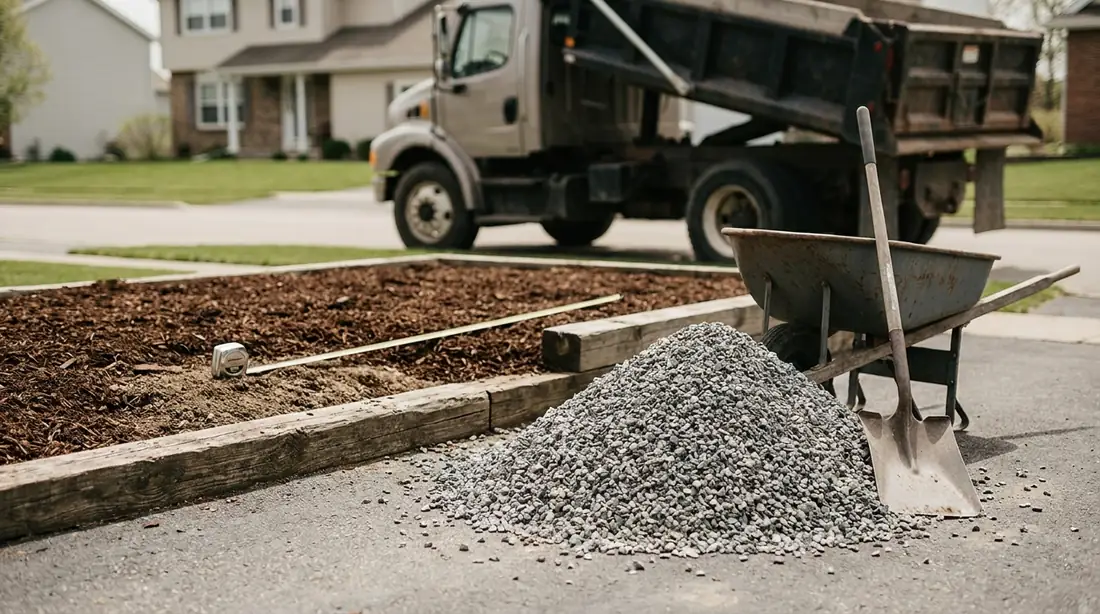
How the cubic yard calculator works
Almost every mistake I see with yardage comes from one place: mixing units. People measure a bed in feet, pick a depth in inches, and then multiply all three together as though they matched. The result is off by a factor of twelve, and it usually surfaces when a delivery arrives and covers a third of what it was supposed to.
So the calculator above takes depth in inches and everything else in feet, which is how you actually measure a site, and does the conversion itself. Add an area for each part of the job — each one gets its own shape and its own depth — and it sums them. A bed at 3 inches and a path at 4 inches are one order, not two calculations.
What comes out: cubic yards, cubic feet, cubic metres and cubic inches; weight in tons and pounds once you pick a material; the number of bags at any common bag size; how far one yard goes at your depth; a waste allowance; and a cost estimate priced per yard, per foot, per metre, per ton or per bag. Every area is itemised so you can see which part of the job is eating the volume.
The cubic yard formula, and why you divide by 27
The 27 is not an arbitrary conversion factor. A yard is three feet, so a cubic yard is three feet in every direction — 3 × 3 × 3 — and that is 27 cubic feet. Once you have seen it as a cube the number stops needing to be memorised.
cubic yards = (length ft × width ft × depth ft) ÷ 27
depth ft = depth in ÷ 12
Worked through on a 10 by 10 foot slab at 4 inches: depth becomes 4 ÷ 12 = 0.333 ft, the volume is 10 × 10 × 0.333 = 33.33 cubic feet, and 33.33 ÷ 27 = 1.2346 cubic yards. Suppliers round that to 1.25 or simply sell you a yard and a half.
The exactness is worth a sentence. A yard has been defined as precisely 0.9144 metres since the international agreement of 1959, so a cubic yard is exactly 0.764554857984 cubic metres and exactly 46,656 cubic inches. Nothing in the conversion is approximate — NIST publishes the definition if you want the primary source. What is approximate is everything downstream: your tape measure, the flatness of the ground, and how much the driver actually tips out.
| Project | Size | Depth | Cubic feet | Cubic yards | Order with 10% |
|---|---|---|---|---|---|
| Concrete slab | 10 × 10 ft | 4 in | 33.3 | 1.23 | 1.36 |
| Concrete slab | 20 × 20 ft | 4 in | 133.3 | 4.94 | 5.43 |
| Patio | 12 × 12 ft | 4 in | 48.0 | 1.78 | 1.96 |
| Driveway | 20 × 10 ft | 6 in | 100.0 | 3.70 | 4.07 |
| Strip footing | 40 × 1 ft | 12 in | 40.0 | 1.48 | 1.63 |
| Flower bed | 20 × 4 ft | 6 in | 40.0 | 1.48 | 1.63 |
| Garden mulch | 30 × 30 ft | 3 in | 225.0 | 8.33 | 9.17 |
| Gravel path | 50 × 3 ft | 4 in | 50.0 | 1.85 | 2.04 |
| Raised bed | 8 × 4 ft | 10 in | 26.7 | 0.99 | 1.09 |
Converting square feet to cubic yards
This is the conversion people search for most, and strictly speaking it cannot be done. Square feet measure a surface; cubic yards measure a volume. Without a depth there is no answer — 500 square feet could be a tenth of a yard or ten yards depending on how thick you lay it.
Given a depth, the arithmetic collapses to one step:
cubic yards = (square feet × depth in inches) ÷ 324
That 324 is the same number as the coverage rule below, just rearranged. So 500 square feet at 3 inches deep is (500 × 3) ÷ 324 = 4.63 cubic yards. In the calculator, pick I already know the area as the shape and enter your square footage directly — no need to invent a length and width that multiply back to it.
How much ground does one cubic yard cover?
A cubic yard covers 324 square feet spread one inch thick. Every other figure is that number divided by the depth, and it is the single most useful thing to carry in your head on a landscaping job.
| Depth | One cubic yard covers | In square yards | yd³ per 100 sq ft |
|---|---|---|---|
| 1 in | 324 sq ft | 36.0 sq yd | 0.309 |
| 2 in | 162 sq ft | 18.0 sq yd | 0.617 |
| 3 in | 108 sq ft | 12.0 sq yd | 0.926 |
| 4 in | 81 sq ft | 9.0 sq yd | 1.235 |
| 5 in | 65 sq ft | 7.2 sq yd | 1.543 |
| 6 in | 54 sq ft | 6.0 sq yd | 1.852 |
| 8 in | 40 sq ft | 4.5 sq yd | 2.469 |
| 10 in | 32 sq ft | 3.6 sq yd | 3.086 |
| 12 in | 27 sq ft | 3.0 sq yd | 3.704 |
The practical consequence is that depth, not area, decides your order. Widening a 20-foot bed by a foot adds about 3% to the volume. Going from 2 inches of mulch to 4 doubles it. When a quote comes back higher than you expected, the depth is almost always where it went.
Cubic yards to tons: weight by material
Volume is what you order and weight is what arrives, and the gap between them decides whether your driveway survives the delivery. A cubic yard of mulch is around 1,000 pounds. The same yard of gravel is nearly 2,800.
| Material | Tons per yd³ | Pounds per yd³ | Kilograms per yd³ | One ton is |
|---|---|---|---|---|
| Concrete | 2.03 | 4,060 lb | 1,842 kg | 0.49 yd³ |
| Gravel | 1.40 | 2,800 lb | 1,270 kg | 0.71 yd³ |
| Sand | 1.35 | 2,700 lb | 1,225 kg | 0.74 yd³ |
| Topsoil | 1.10 | 2,200 lb | 998 kg | 0.91 yd³ |
| Compost | 0.60 | 1,200 lb | 544 kg | 1.67 yd³ |
| Mulch | 0.50 | 1,000 lb | 454 kg | 2.00 yd³ |
Moisture is the variable nobody accounts for. Bark that has sat through a wet week can weigh half as much again as the dry figure, and soil is worse. If you are being charged by weight rather than volume, order after a dry spell and you are buying less water. The calculator deliberately uses the heavier end for mulch so the truck capacity you plan for is the one you need.
Dirt, topsoil and fill: what the yardage changes
Soil is where yardage gets slippery, because there are three different materials sold under names people use interchangeably. Topsoil is screened and sold to grow things in. Fill dirt is subsoil, cheaper and denser, sold to take up space under something else. Garden or veggie soil is topsoil already blended with compost, which makes it lighter per yard than either.
The volume maths is identical for all three; what changes is depth and waste. Fill goes in deep and compacts hard, so order 10 to 15 percent over. Topsoil for a lawn goes down 2 to 4 inches and settles far less. And a raised bed is the one case where people routinely under-order: an 8 by 4 foot bed at 10 inches deep needs 0.99 cubic yards, which is most of a delivery for what looks like a small box.
If your soil is going onto beds rather than into a hole, the landscaping and mulch calculator handles bark, compost and topsoil together with bag counts and coverage already built in.
Bagged or bulk, and how many bags make a yard
The crossover sits at roughly one cubic yard. Below it, bags usually win — no delivery fee, no minimum order, nothing left over on the driveway. Above it, bulk wins on price and on your back.
| Bag | Volume | Bags per cubic yard | Typically |
|---|---|---|---|
| 2 cu ft bag | 2 cu ft | 13.5 | Bark mulch, the common big bag |
| 1.5 cu ft bag | 1.5 cu ft | 18.0 | Mulch and bagged soil |
| 1 cu ft bag | 1 cu ft | 27.0 | Potting and garden soil |
| 0.75 cu ft bag | 0.75 cu ft | 36.0 | Small soil and amendment bags |
| 0.5 cu ft bag | 0.5 cu ft | 54.0 | Stone and decorative aggregate |
| 80 lb concrete mix | 0.6 cu ft | 45.0 | Yields about 0.60 cu ft |
| 60 lb concrete mix | 0.45 cu ft | 60.0 | Yields about 0.45 cu ft |
| 50 lb concrete mix | 0.375 cu ft | 72.0 | Yields about 0.375 cu ft |
| 40 lb concrete mix | 0.3 cu ft | 90.0 | Yields about 0.30 cu ft |
Concrete is the case that surprises people. An 80-pound bag sounds substantial but yields only about 0.60 cubic feet, so a single cubic yard takes 45 of them — over 1.8 tons of bags to mix by hand. Those yields are the manufacturers' own published figures; Quikrete lists them per product, and they vary slightly by mix. For anything past half a yard of concrete, ready-mix delivery is almost always the better call, and the concrete calculator works in bags and trucks directly.
Bank, loose and compacted yards
Here is the one that catches people out on excavation jobs, and not one of the calculators competing for this search mentions it. A cubic yard of soil is three different volumes depending on where it is standing.
- Bank cubic yards — the soil undisturbed, in the ground. This is what you measure off a grading plan and what you are paying to excavate.
- Loose cubic yards — the same soil after digging, broken up and full of air. Sand and gravel swell 10 to 20 percent, loam and common earth 20 to 30 percent, heavy clay 30 to 40 percent. This is the volume that fills the trucks.
- Compacted cubic yards — the same soil placed and rolled. Most soils finish 10 to 20 percent below their bank volume.
So one bank yard of common earth becomes roughly 1.25 loose yards on the truck, then settles to about 0.9 compacted yards once it is placed. Dig a 100-yard hole and you are hauling around 125 yards away; fill a 100-yard void and you need to buy closer to 110 bank yards to end up level.
Depth by project, and how much to add for waste
Waste is not optional and it is not padding. Material settles, spills, disappears into low spots and gets raked past the edges, and a second delivery costs far more than 10 percent of a first one.
| Job | Usual depth | Add for waste | Why |
|---|---|---|---|
| Garden beds, mulch | 2–3 in | 5–10% | Keep it off the stems; deeper is not better. |
| Tree rings | 2–3 in | 5–10% | Leave a mulch-free ring at the trunk. |
| Mulch paths | 3–4 in | 5–10% | Edging stops it walking away. |
| Playground mulch | 8–12 in | 10–20% | Follow the safety-surfacing spec, not a rule of thumb. |
| Gravel paths | 3–4 in | 10–15% | Compact in layers; the surface drops as you go. |
| Gravel base under pavers | 4–6 in | 10–15% | Depth depends on the subgrade and the load. |
| Topsoil grading | 2–4 in | 5–10% | Low spots eat more than you expect. |
| Lawn topdressing | ¼–½ in | 5% | Thin layers only, or you smother the grass. |
| Concrete slab | 4 in typical | 5–10% | Spillage, edge forms and an uneven subgrade. |
The calculator applies your chosen percentage to the whole order and shows both figures, so you can see what you are actually paying for. If you are covering a driveway rather than a bed, the asphalt calculator works in tons rather than yards, which is how asphalt is sold.
Odd shapes: circles, triangles and irregular areas
Real sites are rarely rectangles. The calculator handles squares, rectangles, circles, rings, triangles and trapezoids directly, and it will take a raw square footage if you have already worked the area out elsewhere.
For a circular bed, measure across the widest point — the diameter, not the radius, which is the commonest input error on any circle calculator. For a ring around a tree or a patio, use the circle-border shape and give it both diameters; it subtracts the middle for you. For anything genuinely irregular, break it into pieces: add one area per piece, and let the totals add up. Two triangles and a rectangle will get you within a few percent of almost any garden bed, and a few percent is inside your waste allowance anyway.
More estimating tools for the rest of the build sit in the construction calculators collection.
Frequently asked questions
How do you calculate cubic yards?
Multiply length by width by depth with every measurement in feet, then divide by 27. If your depth is in inches, divide it by 12 first — a 4-inch pour is 4 ÷ 12 = 0.333 feet. A slab 10 feet by 10 feet at 4 inches deep works out at 33.33 cubic feet, and 33.33 ÷ 27 = 1.23 cubic yards. The divide-by-27 step exists because a cubic yard is a cube three feet on every side.
How much will 1 cubic yard cover?
One cubic yard covers 324 square feet at 1 inch deep, 162 square feet at 2 inches, 108 at 3 inches, 81 at 4 inches and 54 at 6 inches. The rule is 324 ÷ depth in inches. That 324 comes from slicing the yard into 36 one-inch layers of 9 square feet each. Depth is doing all the work here, which is why a shallow mulch job covers so much more ground than a slab of the same volume.
Is 27 cubic feet equal to 1 cubic yard?
Yes, exactly 27. A yard is 3 feet, so a cubic yard is 3 × 3 × 3 = 27 cubic feet. The same cube is 46,656 cubic inches and 0.7646 cubic metres. Nothing is rounded in that conversion — the international yard has been defined as exactly 0.9144 metres since 1959, so every one of these figures is exact rather than approximate.
Is a cubic yard 3x3x3?
Yes — three feet in every direction, so roughly the size of a large washing machine. That is worth picturing before you order, because a cubic yard of gravel weighs around 2,800 pounds and will not fit in a half-ton pickup. Most half-ton trucks handle about half a yard of heavy material or a full yard of light bark, and suppliers usually deliver bulk in whole yards only.
How do I convert cubic yards to tons?
Multiply cubic yards by the material's density in tons per cubic yard. Concrete is about 2.03 tons per yard, gravel 1.4, sand 1.35, topsoil 1.1, compost 0.6 and bark mulch around 0.5. So 3 cubic yards of gravel is 3 × 1.4 = 4.2 tons. Moisture moves these figures more than anything else, so treat them as ordering estimates and check the supplier's own weights for a paid-by-weight load.
How much does a cubic yard of dirt weigh?
A cubic yard of topsoil weighs roughly 2,200 pounds, or 1.1 tons, when it is reasonably dry. Wet soil is heavier — water alone adds hundreds of pounds per yard — and screened topsoil weighs less than dense fill. Compare that with gravel at about 2,800 pounds and mulch at around 1,000, and it becomes obvious why the same truck carries very different yardages depending on what is in the back.
How many bags of mulch are in a cubic yard?
Thirteen and a half 2-cubic-foot bags make one cubic yard, because 27 ÷ 2 = 13.5. For the smaller sizes it is 18 bags at 1.5 cubic feet, 27 bags at 1 cubic foot and 54 bags at half a cubic foot. Since you cannot buy half a bag, round up to 14. Past roughly one yard, bulk delivery is normally cheaper per yard than bagged — and considerably less lifting.
How many bags of concrete make a cubic yard?
Forty-five 80-pound bags, 60 bags of the 60-pound size, or 90 of the 40-pound bags. Bagged concrete is sold by weight but mixes to a published volume: an 80-pound bag yields about 0.60 cubic feet, so 27 ÷ 0.60 = 45. That is well over a ton of bags for a single yard, which is the point at which ready-mix delivery usually wins on both cost and effort.
How many cubic yards of concrete do I need for a slab?
Multiply the slab's length by its width by its thickness in feet, then divide by 27. A 10 by 10 foot slab at 4 inches thick needs 1.23 cubic yards; a 12 by 12 foot patio at the same thickness needs 1.78. Order 5 to 10 percent more than the calculation gives you, because subgrades are never perfectly level and the low spots quietly absorb the difference.
How do I measure odd or curved areas?
Split the space into shapes you can measure — rectangles, triangles, circles — work out each one separately, then add the volumes. The calculator above does this for you: add an area for each section, give each its own shape and depth, and it sums them. For a genuinely irregular outline, a decent approximation is to overlay the largest rectangle that fits and treat the leftovers as triangles.