
Did you like the tool?
Did we solve your problem?
Rate the tool
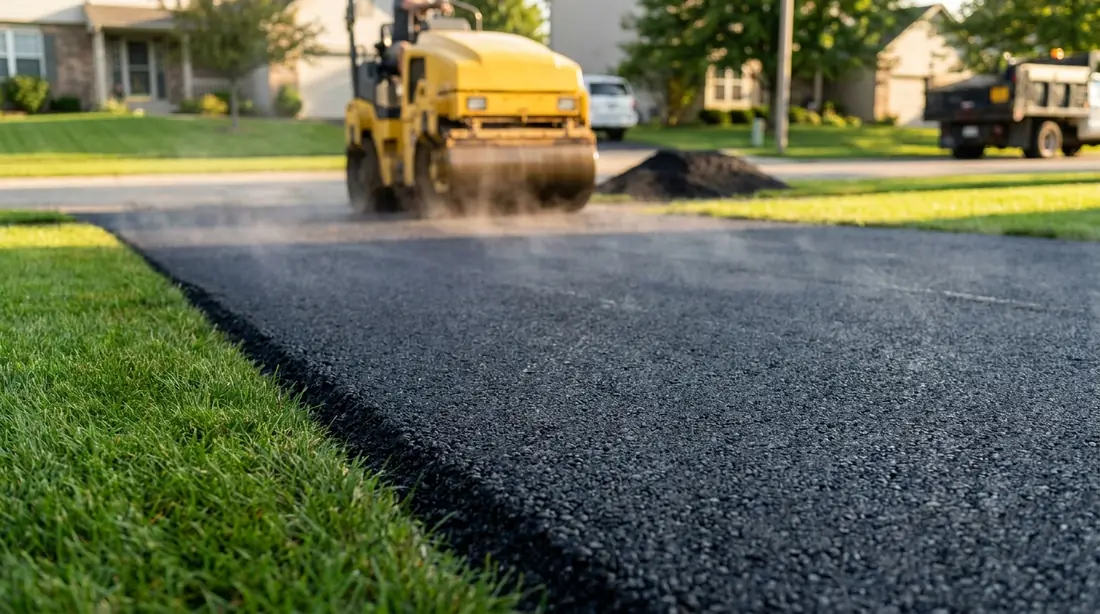
How to calculate asphalt tonnage
Asphalt is bought by the ton but measured on the ground in square feet, and that mismatch is the whole reason this calculation trips people up. The route between the two is short:
Tons = area (ft²) × thickness (ft) × density (lb/ft³) ÷ 2,000
Or the shortcut every estimator carries in their head: tons = (square feet × inches) ÷ 166
The 166 comes straight out of the density. One ton of hot mix at 145 lb/ft³ occupies 13.79 cubic feet, and spreading that over an inch of depth covers 165.5 square feet — so 166 square-feet-inches per ton, near enough.
A worked example
Say you are paving a 20 ft by 30 ft parking pad at 6 inches compacted. The area is 600 sq ft, and 6 inches is half a foot, so the volume is 300 cubic feet. Multiply by 145 lb/ft³ and you get 43,500 lb, which is 21.75 tons. Add a 5% waste allowance and you would order about 22.8 tons.
Asphalt coverage chart
Depth changes tonnage more than people expect, because it multiplies straight through. Doubling the thickness doubles the asphalt.
| Compacted thickness | One ton covers | Tons for 1,000 sq ft | |
|---|---|---|---|
| sq ft | sq yd | ||
| 1 in | 165.5 | 18.4 | 6.04 |
| 1.5 in | 110.3 | 12.3 | 9.06 |
| 2 in | 82.8 | 9.2 | 12.08 |
| 2.5 in | 66.2 | 7.4 | 15.10 |
| 3 in | 55.2 | 6.1 | 18.12 |
| 4 in | 41.4 | 4.6 | 24.17 |
| 5 in | 33.1 | 3.7 | 30.21 |
| 6 in | 27.6 | 3.1 | 36.25 |
How thick should asphalt be?
Thickness is where estimates go wrong most often, and where the advice online contradicts itself most sharply. The figures below follow the Asphalt Institute, FHWA and state asphalt-association guidance rather than any single contractor’s house rule.
| Application | Compacted asphalt thickness | Notes |
|---|---|---|
| Residential driveway — surface course only | 1.5–2 in | Over an existing sound base |
| Residential driveway — asphalt over aggregate base | 3 in asphalt | On 4–8 in of compacted aggregate; deeper where ground freezes |
| Residential driveway — full depth asphalt | 4 in | No aggregate base; 5–6 in for a stronger drive |
| Parking lot — light duty (cars) | 3 in asphalt | On about 6 in of aggregate base |
| Parking lot — heavy duty (trucks) | 6–7 in asphalt | On about 10 in of aggregate base |
| Road surface course | 1.5 in | 2 in on interstate-grade work |
| Overlay / resurfacing | 1.5–2 in | Thin overlays are a separate product under 1.5 in |
| Asphalt millings driveway | 3–4 in | Guidance only — millings are not an engineered pavement |
Asphalt density and weight
Every tonnage figure on this page rests on one number: how much a cubic foot of compacted asphalt weighs. The calculator defaults to 145 lb/ft³, and that default is not arbitrary — two independent routes land on it. Working from mix design, a typical maximum specific gravity of 2.500 gives 156 lb/ft³ solid, and at the 7% air voids a finished mat normally holds you get 145. Working from field practice, the spread rate paving crews and highway agencies use is 110 lb per square yard per inch, which is 146.7 lb/ft³. The two agree within two percent.
| Material | lb / ft³ | lb / yd³ | tons / yd³ |
|---|---|---|---|
| Hot mix asphalt, in place | 142–148 | 3,834–3,996 | 1.92–2.00 |
| Asphalt millings / RAP, compacted | 120–140 | 3,240–3,780 | 1.62–1.89 |
| Aggregate base, compacted in place | 137–148 | 3,700–4,000 | 1.85–2.00 |
Mixes do vary. Heavy traprock aggregate pushes density up, lightweight or open-graded mixes pull it down — an open-graded friction course can run nearer 100 lb per square yard per inch, so a calculator assuming dense-graded would over-order by a fifth. If your supplier quotes a density, type theirs into the calculator instead of the default. The Asphalt Institute is the reference for mix design and in-place density, and FHWA publishes the lift-thickness and overlay guidance the table above follows.
Ordering: waste, minimum loads and cold joints
Order the exact calculated figure and you will come up short. Add five to ten percent for irregular edges, dips in the base and the material that clings inside the truck bed, and push toward fifteen percent on awkward shapes or slopes.
- Running out mid-job is the expensive failure. Where a fresh load meets asphalt that has already cooled you get a cold joint, and that seam stays the weakest line in the pavement for the rest of its life.
- Ask about the minimum load. Plants would rather send a full truck, and small residential orders often carry a surcharge.
- Asphalt does not wait. Hot mix has to be laid and compacted while it is hot, so ordering in one delivery you can actually place beats ordering everything at once.
- Check the base before the truck arrives. Compaction and drainage problems are cheap to fix beforehand and impossible to fix afterwards.
Mistakes that blow the estimate
- Using loose density instead of compacted. The 1.25 factor for laying it thick and rolling it down is a screed-height rule, not a tonnage rule. Apply both and you over-order by roughly a quarter.
- Using a loose figure for aggregate base. Loose stone is often quoted near 1.4 tons per cubic yard, but compacted in place it is 1.85 to 2.00. Against a compacted design volume the loose number leaves you about 25% short.
- Treating millings like hot mix. Recycled asphalt is lighter, 120 to 140 lb/ft³, so the same volume is fewer tons.
- Forgetting depth is compacted, not loose. Three inches means three inches after rolling.
- Sealcoat maths off by double. Coverage of 70 to 82 square feet per gallon is per coat, and the standard job is two coats — so budget nearer 38 square feet per gallon overall.
Working out the aggregate base underneath as well? Our concrete calculator and landscaping material calculator run the same cubic-yard arithmetic for other materials, and the area calculator helps if the shape is more complicated than a rectangle.
Frequently Asked Questions
How do I calculate how much asphalt I need?
Multiply length by width to get the area in square feet, multiply by the compacted thickness in feet (inches divided by 12) to get cubic feet, then multiply by the asphalt density and divide by 2,000 to get tons. At the standard 145 lb/ft³, the whole thing collapses to a shortcut: tons = (square feet × inches) ÷ 166. A 20 ft by 30 ft pad at 6 inches works out to 300 cubic feet, 43,500 lb, or 21.75 tons.
How much does 1 ton of asphalt cover at 2 inches thick?
About 83 square feet, or roughly 9 square yards. The trade rule of thumb is “one ton covers 80 square feet at 2 inches”, which is the same number rounded down so you order slightly long rather than short. At 3 inches one ton covers about 55 square feet, and at 4 inches about 41.
How many tons of asphalt are in a cubic yard?
Close to two. A cubic yard is 27 cubic feet, so at 145 lb/ft³ that is 3,915 lb, or 1.96 tons per cubic yard. Asphalt is sold by weight rather than volume, so cubic yards are mostly useful as a cross-check on your own arithmetic or when you are comparing against a concrete or aggregate quote.
How thick should an asphalt driveway be?
Three inches of compacted asphalt over four to eight inches of aggregate base suits most residential driveways. If you are laying full-depth asphalt with no aggregate underneath, four inches is the working minimum and five to six inches gives a noticeably stronger drive. A surface course over an existing sound base only needs an inch and a half to two inches. Frost depth and soil strength push these numbers up, so check what is normal locally.
How much would a 20x20 asphalt driveway cost?
A 20 by 20 pad is 400 square feet. At a typical 3-inch compacted depth that is about 7.2 tons of hot mix, and adding a 5% waste allowance takes it to roughly 7.6 tons. Multiply by your local price per ton for the material cost. Installed pricing, which includes excavation, base, labour and compaction, runs far higher than material alone and varies enormously by region, so get a quote rather than trusting a national average.
How much is asphalt per ton?
It moves with crude oil, haul distance from the plant and the season, which is why this calculator asks you to enter the price rather than assuming one. Ring your nearest asphalt plant for a current figure, ask whether it includes delivery, and check the minimum load. Small residential jobs often carry a surcharge because a plant would rather run a full truck.
How much asphalt millings do I need?
Work it out the same way, but drop the density. Recycled asphalt compacts to roughly 120–140 lb/ft³ against hot mix at 145, because the old binder coating on the aggregate stops it packing as tightly. That is about 1.62 to 1.89 tons per cubic yard. Millings driveways are usually laid 3 to 4 inches deep. Set the material to millings in the calculator and it adjusts the density for you.
Should I add extra asphalt for waste?
Yes, and five to ten percent is the usual allowance. Irregular edges, slight dips in the base and the material left in the truck all mean the ideal figure and the ordered figure are not the same. Push it toward fifteen percent if the shape is awkward or the ground is uneven. Running short mid-pour is far more expensive than a little surplus, because a cold joint where the new load meets the old is a permanent weak line.
What is the difference between loose and compacted asphalt?
Loose asphalt as it leaves the screed is fluffier than the finished mat, and the usual placement rule is to lay it about 1.25 times the final thickness so it compacts down to spec. That factor matters for setting screed height, not for ordering. Tonnage is the same either way, so a quantity calculator should always work from compacted density. Applying the loose factor to the tonnage as well is a classic double-count that leaves you with a quarter more asphalt than the job needs.
Is asphalt or concrete cheaper for a driveway?
Asphalt is normally cheaper to install and quicker to use after laying, while concrete lasts longer and needs less routine attention. Asphalt wants sealing every few years and will need crack filling as it ages; concrete costs more up front and is harder to patch invisibly. In cold climates asphalt tends to handle freeze-thaw movement better because it flexes rather than cracking.