kW to kVA Calculator
The kW to kVA Calculator helps you instantly convert real power to apparent power and vice versa using power factor. It is useful for sizing UPS systems, generators, transformers, and electrical loads for homes, offices, commercial facilities, and industrial applications.
Ratio of real power to apparent power, from 0.10 to 1.00. Most motor loads sit between 0.75 and 0.90; an unloaded motor can fall near 0.30. UPS and generators are usually rated in kVA.
⚙️ Advanced Mode (Amperage)
📐 Power Triangle
📦 Recommendations
| Min. UPS Size ? | -- |
| Min. Generator ? | -- |
| Est. Line Current | -- |
⚖️ Independent Scenario Comparison
Add rows to compare how different Power Factor values affect required kVA for a fixed kW load.
| Load (kW) | Power Factor | Resulting kVA | Action |
|---|
💰 ROI Savings Calculator
Estimate possible monthly savings by improving power factor.
Did you like the tool?
Did we solve your problem?
Rate the tool
The Number You Type Into a kW to kVA Calculator Matters Less Than the One You Assume
Here is the uncomfortable part of converting between kilowatts and kilovolt-amperes: the arithmetic is trivial, and almost every wrong answer comes from the power factor, not the division.
Type 100 into a converter and you get 125 kVA. That result is only as good as the 0.8 sitting in the second field — a number most people never chose. Change it to 0.95 and the same load needs 105 kVA. That is a 20 kVA swing on one assumption, and at the scale of a distribution transformer or a standby generator, 20 kVA is a different frame size and a materially different quote.
Use the calculator above for the arithmetic, and use what follows to make sure the power factor you feed it reflects the actual load — motors, lighting, or a rack of servers all behave differently.
Converting kVA to kW Is the Direction Most People Actually Need
Most reference pages lead with kW to kVA. In practice the reverse comes up more often, because equipment arrives already labelled in kVA and you need to know what it will really do.
A generator is stamped 100 kVA. An uninterruptible power supply is stamped 10 kVA. A distribution transformer is stamped 500 kVA. None of those numbers tell you the useful output. To get that:
A 100 kVA genset at the standard 0.8 power factor delivers 80 kW of real power. The remaining capacity is not lost — it is reactive power circulating between the source and the load's magnetic fields, doing no work but occupying conductor and alternator capacity all the same.
Going the other way, when you know the load and need the equipment rating:
An 80 kW load at 0.8 requires 100 kVA of apparent power. And the relationship that lets you check your own figures:
Power factor is nothing more mysterious than the ratio of the two. It is the cosine of the phase angle between the voltage and current waveform — written cos φ — and it runs from 0 to 1.0. If you want the underlying theory, power factor fundamentals covers the derivation.
kW to kVA Formula for Single-Phase and Three-Phase Systems
This is where most calculators quietly stop, and it is the single most-searched thing about the topic. The power-factor formulas above hold for both. The moment you introduce voltage and current, the two systems diverge.
Single-phase kW to kVA
With one live conductor and a neutral — most residential supply, small commercial equipment — apparent power in kilovolt-amps is simply the product of the two measured quantities:
A 240 V single-phase circuit drawing 41.7 A of current is handling about 10 kVA. At 0.8 power factor that is 8 kW of real power. On a 120 V branch circuit the same current would represent half that. Reverse the formula to size the circuit from a known load:
Three-phase kW to kVA
Three-phase adds the square root of three — 1.732 — because the three windings are 120° apart and their contributions sum vectorially, not arithmetically. Using line-to-line voltage:
Forgetting the √3 is the most common error in this whole subject, and it under-reports capacity by 42%. Wire an installation on that number and the conductors run hot.
The formula is the same whether the supply is a three-wire delta or a four-wire wye — what changes is which voltage you read, so confirm you are using line-to-line and not line-to-neutral.
Converting kVA to amps
Rearranged, the same formula sizes the feeder — which is usually the real reason anyone opened a converter:
The same 100 kVA produces a very different current draw depending on the system voltage:
| System | Voltage | Current at 100 kVA |
|---|---|---|
| Three-phase (North America, commercial, 60 Hz) | 480 V | 120.3 A |
| Three-phase (North America, building, 60 Hz) | 208 V | 277.6 A |
| Three-phase (Europe / UK / GCC, 50 Hz) | 400 V | 144.3 A |
That 208 V row is why the same apparent power can mean a 150 A breaker or a 400 A one. The kVA figure is voltage-agnostic; the copper is not, and neither is the switchgear — busbar ratings, circuit breaker frame sizes and overcurrent protection are all specified in amperes, never in kVA. Once you have the amperage, our Cable Size Calculator and Voltage Drop Calculator will size the conductor and confirm the run length is within limits. If you are working in AWG rather than metric, the wire gauge calculator converts between the two.
kVA to kW Conversion Chart
Rather than converting one value at a time, this conversion table covers the standard equipment ratings at the three power factors you will actually meet: 0.8 (generators and mixed inductive load), 0.9 (corrected commercial), and 1.0 (purely resistive).
| kVA | kW at 0.8 | kW at 0.9 | kW at 1.0 |
|---|---|---|---|
| 1 | 0.8 | 0.9 | 1 |
| 5 | 4 | 4.5 | 5 |
| 6 | 4.8 | 5.4 | 6 |
| 10 | 8 | 9 | 10 |
| 15 | 12 | 13.5 | 15 |
| 20 | 16 | 18 | 20 |
| 25 | 20 | 22.5 | 25 |
| 30 | 24 | 27 | 30 |
| 45 | 36 | 40.5 | 45 |
| 50 | 40 | 45 | 50 |
| 65 | 52 | 58.5 | 65 |
| 70 | 56 | 63 | 70 |
| 75 | 60 | 67.5 | 75 |
| 80 | 64 | 72 | 80 |
| 85 | 68 | 76.5 | 85 |
| 90 | 72 | 81 | 90 |
| 100 | 80 | 90 | 100 |
| 125 | 100 | 112.5 | 125 |
| 150 | 120 | 135 | 150 |
| 180 | 144 | 162 | 180 |
| 200 | 160 | 180 | 200 |
| 220 | 176 | 198 | 220 |
| 225 | 180 | 202.5 | 225 |
| 250 | 200 | 225 | 250 |
| 300 | 240 | 270 | 300 |
| 350 | 280 | 315 | 350 |
| 400 | 320 | 360 | 400 |
| 450 | 360 | 405 | 450 |
| 500 | 400 | 450 | 500 |
| 600 | 480 | 540 | 600 |
| 750 | 600 | 675 | 750 |
| 1000 | 800 | 900 | 1000 |
| 1250 | 1000 | 1125 | 1250 |
| 2000 | 1600 | 1800 | 2000 |
| 2500 | 2000 | 2250 | 2500 |
kW to kVA Conversion Chart
The same relationship inverted — start with the load, find the equipment rating. Divide by the power factor, or multiply by 1.25 for the 0.8 column.
| kW | kVA at 0.8 | kVA at 0.9 | kVA at 1.0 |
|---|---|---|---|
| 1 | 1.25 | 1.11 | 1 |
| 5 | 6.25 | 5.56 | 5 |
| 10 | 12.5 | 11.11 | 10 |
| 15 | 18.75 | 16.67 | 15 |
| 20 | 25 | 22.22 | 20 |
| 25 | 31.25 | 27.78 | 25 |
| 30 | 37.5 | 33.33 | 30 |
| 40 | 50 | 44.44 | 40 |
| 50 | 62.5 | 55.56 | 50 |
| 75 | 93.75 | 83.33 | 75 |
| 100 | 125 | 111.11 | 100 |
| 125 | 156.25 | 138.89 | 125 |
| 150 | 187.5 | 166.67 | 150 |
| 200 | 250 | 222.22 | 200 |
| 250 | 312.5 | 277.78 | 250 |
| 300 | 375 | 333.33 | 300 |
| 400 | 500 | 444.44 | 400 |
| 500 | 625 | 555.56 | 500 |
| 750 | 937.5 | 833.33 | 750 |
| 1000 | 1250 | 1111.11 | 1000 |
Why Generators Are Rated in kVA but Sold on kW
Ask a supplier for a 100 kW generator and the quote comes back for a 125 kVA machine. That is not a markup — it is two different components being rated honestly.
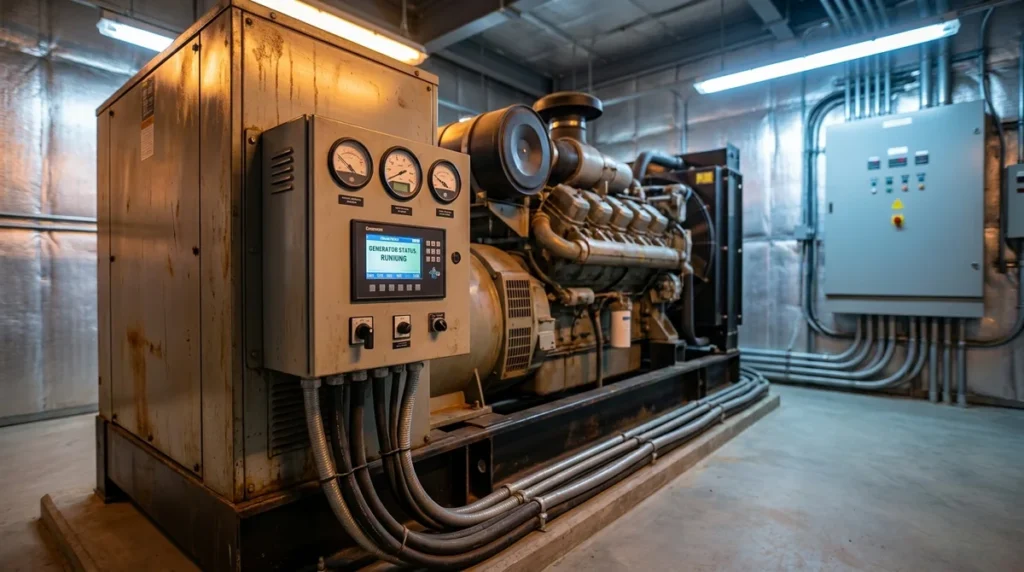
The alternator is limited by current, because current is what heats its windings. Current tracks apparent power, so the alternator is rated in kVA. The diesel engine behind it — the prime mover — is limited by the torque it can produce, which tracks real power, so it is rated in kW. Bolt them together at the industry-standard 0.8 power factor and the pairing is 125 kVA / 100 kW.
Two practical consequences follow.
Feed that set a load with a better power factor than 0.8 and you cannot recover the difference. A 125 kVA genset on a unity-power-factor resistive load still only makes 100 kW, because the engine runs out of torque first. The alternator has headroom the prime mover cannot use.
Feed it a worse power factor and the alternator hits its thermal rating before the engine is loaded. You are paying for a 100 kW engine and getting perhaps 70 kW of usable output.
Ratings are also quoted against a duty definition. Prime power assumes the set is the main supply and runs for extended periods at variable load; standby power assumes it only covers utility outages and carries a higher short-term rating it could not sustain continuously. The same machine therefore carries two different kW numbers, and a commissioning load bank test is the only way to confirm either under a known continuous load.
This is also why sizing guidance adds a safety margin on top of the calculated figure — the calculator above applies 25% for UPS sizing and 50% for generators, since a genset also has to swallow motor starting. It covers motor starting, where inrush current briefly reaches six to eight times full load amperes, along with future load growth and the derating that altitude and ambient temperature impose. Undersizing produces voltage dips that trip sensitive equipment; gross oversizing causes wet stacking in a lightly loaded diesel.
For a full sizing pass including step loads, use our Generator Sizing Calculator, and for runtime on the battery side, the Battery Backup Calculator doubles as a UPS Battery Calculator. Where a motor is the dominant load, the motor current calculator gives full-load amperes directly from horsepower, and the short circuit current calculator checks that the switchgear interrupting rating is adequate.
Power Factor, Reactive Power, and the Power Triangle
The three quantities form a right triangle. Real power is the base, reactive power the vertical, apparent power the hypotenuse:
So reactive power is recoverable from the other two:
Our 100 kVA / 80 kW example gives √(10000 − 6400) = 60 kVAR. A clean 3-4-5 triangle, which is why 0.8 is such a convenient teaching value.
None of this exists on a direct current system, where there is no phase angle to speak of and watts are watts. Power factor is purely an alternating current phenomenon: it describes how far the current sine wave has shifted relative to the voltage sine wave, and therefore how much of the delivered capacity converts into work. In that sense it is a measure of delivery efficiency rather than equipment efficiency — a motor can be highly efficient at turning watts into torque while still presenting a poor power factor to the supply.
What sets the power factor is the character of the load:
- Resistive load — a resistive heater, incandescent lighting, or any straightforward heating element — draws current in phase with voltage. Power factor 1.0, and kVA equals kW. A purely resistive lighting load is the one case where the two units are interchangeable.
- Inductive load — the induction motor, transformer, compressor, pump, elevator, welding set, HVAC plant — builds a magnetic field that returns energy to the supply each cycle. Current lags voltage: a lagging power factor, typically 0.75 to 0.85 unloaded to loaded.
- Capacitive load — capacitor banks, some solar inverter and battery inverter front ends — pushes current ahead of voltage, a leading power factor. This is what a capacitor bank exploits to cancel motor lag.
Modern electronics complicate the picture. A variable frequency drive or switch-mode supply can show near-unity displacement power factor while injecting harmonic distortion that raises RMS current well above what the simple cosine predicts. On a data center or server room feeder, size on measured RMS current rather than a nameplate power factor. Electrical4U has a good treatment of displacement versus distortion power factor if you need to go deeper.
Poor power factor is billed, not just tolerated. Utilities levy a utility penalty or raise the demand charge when it drops below a threshold — often 0.9 — because the utility meter records the current their network had to carry regardless of the work done. That reactive current also has to pass through every step-down transformer between the substation and your panel, which is why the pad-mounted unit serving a site is sized in kVA and why correcting power factor at the load frees capacity all the way upstream. On a large site the billing impact alone usually justifies the capacitors.
Our Power Factor Calculator sizes the capacitor bank, the transformer load calculator checks the released headroom upstream, and the Electrical Load Calculator converts the corrected real power into kilowatt-hour cost.
NEC 220.55 — Where kVA and kW Are Treated as Equal
One clause trips people up often enough to deserve its own note. NEC 220.55 and its household-cooking-appliance demand table state that kVA is considered equivalent to kilowatts for load calculation purposes.
That is not a claim that the physics changed. It is a deliberate simplification in the National Electrical Code: the appliances in scope — ranges, ovens, cooktops — are essentially resistive, so their power factor really is close to unity, and the code writers removed a conversion step that would have changed nothing. Apply the same shortcut to a motor-driven connected load on a panel schedule and you will undersize the service entrance. The demand factor tables handle diversity; they do not handle power factor.
The general rule: kVA equals kW only at unity power factor. Everywhere else, convert.
Five Mistakes That Wreck a kVA Calculation
- Dropping the √3 on three-phase. The single most expensive error here. Always confirm whether you are working from line-to-line voltage or phase voltage — a wye system's 400 V line-to-line is 230 V line-to-neutral, and mixing them scrambles the result.
- Accepting 0.8 without checking. It is a generator convention, not a universal constant. A server room may run 0.95 or better; an unloaded induction motor can sit near 0.3.
- Using the nameplate rating as the actual load. Nameplate is a maximum, not a measurement. Sizing on connected nameplate values instead of measured demand routinely produces equipment twice the size needed.
- Ignoring inrush. Steady-state kVA says nothing about the moment a large motor starts and draws locked-rotor current. Check the step-load capability, not just the running figure.
- Forgetting derating. Altitude, ambient temperature, duty cycle and continuous-load rules all reduce usable output from the nameplate figure. Same for conductor ampacity in a hot ceiling void.
More conversions and sizing tools for this kind of work live in our Engineering Toolbox.
Frequently Asked Questions
How do I convert kW to kVA?
Divide the real power in kilowatts by the power factor: S(kVA) = P(kW) ÷ PF. For a 50 kW load at 0.8 power factor, 50 ÷ 0.8 = 62.5 kVA. If you are working from voltage and current instead, use S(kVA) = V × I ÷ 1000 for single-phase, or S(kVA) = √3 × V × I ÷ 1000 for three-phase, where V is the line-to-line voltage. The power factor is the only variable that changes the answer, so confirm it reflects your actual load rather than defaulting to 0.8.
What is 25 kW in kVA?
At the standard 0.8 power factor, 25 kW equals 31.25 kVA (25 ÷ 0.8). At 0.9 it is 27.78 kVA, and at unity power factor it is simply 25 kVA. For equipment selection you would round up to the next standard frame size — typically a 30 kVA or 37.5 kVA unit — and then add a safety margin for motor starting and load growth, which commonly puts a 25 kW requirement onto a 40 kVA machine.
Is 1 kVA equal to 1 kW?
Only when the power factor is exactly 1.0, which happens with purely resistive loads such as heaters and incandescent lighting. At the more typical 0.8 power factor, 1 kVA delivers just 0.8 kW of real power. The difference is reactive power — energy that flows back and forth between the supply and the load's magnetic or electric fields without doing useful work, yet still occupies capacity in every conductor, breaker and transformer along the way.
How much is 10 kW in kVA?
10 kW at 0.8 power factor is 12.5 kVA. At 0.9 it is 11.11 kVA, and at unity it stays 10 kVA. This is a common domestic standby generator size: a 12.5 kVA set is marketed as a 10 kW machine because the engine, not the alternator, sets the real-power limit. Remember the rating assumes continuous duty at rated conditions, so derate for altitude and high ambient temperature.
How do I convert kVA to kW?
Multiply the apparent power by the power factor: P(kW) = S(kVA) × PF. A 100 kVA transformer at 0.8 power factor supports 80 kW of real load. This direction is the one you need when equipment is already labelled — gensets, UPS units and distribution transformers are all rated in kVA, because their limiting factor is current rather than work done.
What is the kVA to kW formula for 3 phase?
The conversion between apparent and real power is identical in single-phase and three-phase: P(kW) = S(kVA) × PF. Three-phase only differs when you bring voltage and current in, where the √3 factor (1.732) applies: S(kVA) = √3 × V × I ÷ 1000. So a three-phase load at 415 V drawing 100 A is 1.732 × 415 × 100 ÷ 1000 = 71.9 kVA, and at 0.85 power factor that is 61.1 kW of real power.
How do I calculate kVA from kW and amps?
You need the voltage as well — kW and amps alone are not sufficient, because the power factor links them. The cleanest route is to skip kW entirely and work from voltage and current directly: single-phase, S(kVA) = V × I ÷ 1000; three-phase, S(kVA) = √3 × V × I ÷ 1000. If you only have kW and amps, derive the power factor first with PF = P(kW) × 1000 ÷ (√3 × V × I), then apply the standard conversion.
Why do generator manufacturers use 0.8 power factor?
It is a long-standing industry convention that matches the mixed inductive load a set typically supplies — motors, pumps, compressors and lighting rather than pure resistance. Rating at 0.8 lets the manufacturer pair an alternator limited by current with an engine limited by torque, producing the familiar 125 kVA / 100 kW pairing. It is a design assumption, not a measurement of your site, so verify your actual power factor before sizing.
Conversions here follow standard AC power relationships and assume balanced, sinusoidal three-phase conditions. Real installations involve unbalanced loads, harmonic distortion, altitude and temperature derating, and code requirements that vary by jurisdiction. Use these figures for planning and verification, and have a licensed electrical engineer confirm any final design before installation.