
Did you like the tool?
Did we solve your problem?
Rate the tool
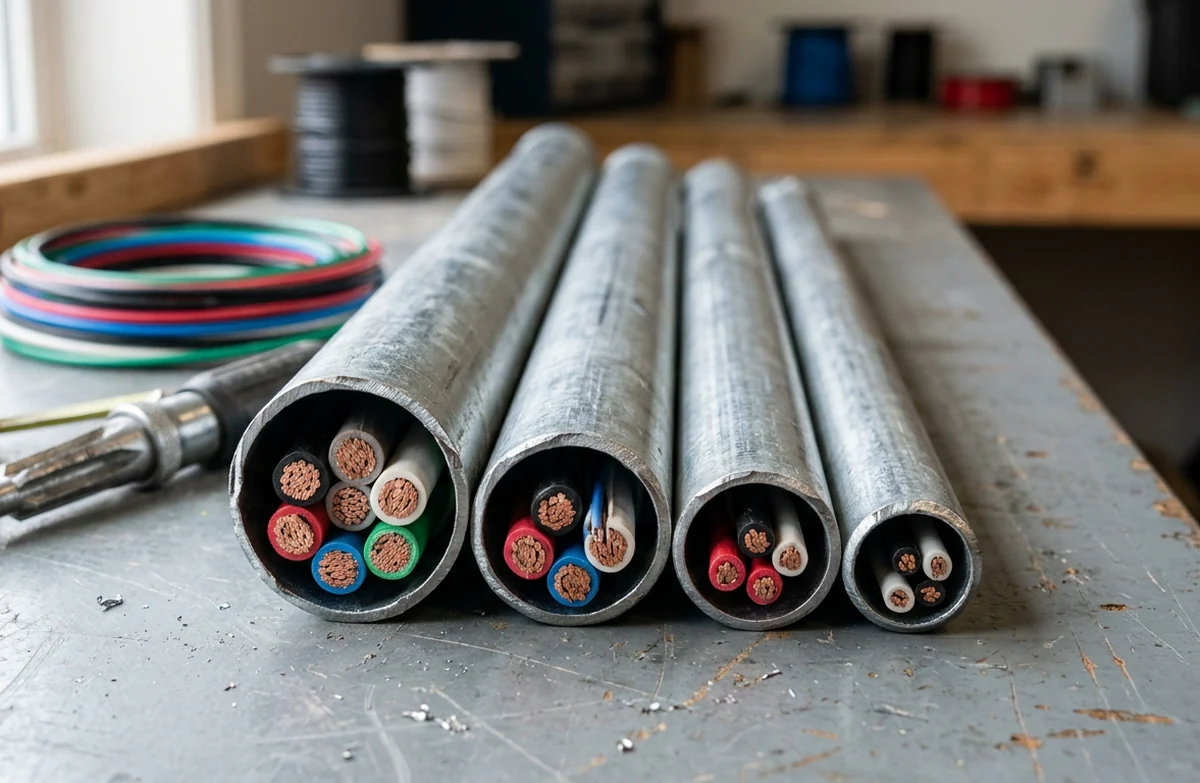
How to calculate conduit fill by hand
The arithmetic behind the calculator is short enough to do on the back of a job sheet, and knowing it matters because it tells you which number to question when a result looks wrong.
Fill % = (total conductor area ÷ conduit internal area) × 100
Both areas come straight out of NEC Chapter 9. Conductor areas are in Table 5 and are measured over the insulation, not the bare copper. Conduit areas are in Table 4, listed per type and trade size. Then compare your answer against the limit in Table 1.
A worked example
Say you are pulling 6 conductors of 12 AWG THHN into 3/4-inch EMT. Each conductor is 0.0133 in², so the bundle is 6 × 0.0133 = 0.0798 in². That size of EMT has 0.533 in² inside it. With more than two conductors the ceiling is 40%, which gives you 0.533 × 0.40 = 0.2132 in² to play with. Your actual fill lands at 0.0798 ÷ 0.533 = 15.0%, comfortably inside the limit. Conduit fill governs the raceway; the box those conductors land in is a separate calculation under NEC 314.16, which the box fill calculator handles.
One quirk worth knowing: when every conductor is the same size, Note 7 of Table 1 lets a decimal of 0.8 or higher round up. That is why the NEC permits 26 conductors of 12 AWG THHN in 1-inch EMT even though the raw division stops just short of it.
Conduit fill chart: how many wires fit
These charts assume THHN/THWN conductors, all the same size, at the 40% limit that applies to three or more conductors. They are generated from the Table 4 and Table 5 figures and follow the Note 7 rounding rule, so they line up with the counts printed in NEC Annex C.
EMT conduit fill chart
| Conductor size (AWG) | Conduit trade size (inches) | |||||||||
|---|---|---|---|---|---|---|---|---|---|---|
| 1/2" | 3/4" | 1" | 1-1/4" | 1-1/2" | 2" | 2-1/2" | 3" | 3-1/2" | 4" | |
| 14 | 12 | 22 | 35 | 61 | 84 | 138 | 241 | 364 | 476 | 608 |
| 12 | 9 | 16 | 26 | 45 | 61 | 101 | 176 | 266 | 347 | 443 |
| 10 | 5 | 10 | 16 | 28 | 38 | 63 | 111 | 167 | 219 | 279 |
| 8 | 3 | 6 | 9 | 16 | 22 | 36 | 64 | 96 | 126 | 161 |
| 6 | 2 | 4 | 7 | 12 | 16 | 26 | 46 | 69 | 91 | 116 |
| 4 | 1 | 2 | 4 | 7 | 10 | 16 | 28 | 43 | 56 | 71 |
| 3 | 1 | 2 | 3 | 6 | 8 | 13 | 24 | 36 | 47 | 60 |
| 2 | 1 | 2 | 3 | 5 | 7 | 11 | 20 | 30 | 40 | 51 |
| 1 | — | 1 | 2 | 4 | 5 | 8 | 15 | 22 | 29 | 37 |
| 1/0 | — | 1 | 2 | 3 | 4 | 7 | 12 | 19 | 25 | 32 |
| 2/0 | — | 1 | 1 | 2 | 3 | 6 | 10 | 16 | 20 | 26 |
| 3/0 | — | — | 1 | 2 | 3 | 5 | 8 | 13 | 17 | 22 |
| 4/0 | — | — | 1 | 2 | 2 | 4 | 7 | 11 | 14 | 18 |
PVC Schedule 40 conduit fill chart
| Conductor size (AWG) | Conduit trade size (inches) | |||||||||
|---|---|---|---|---|---|---|---|---|---|---|
| 1/2" | 3/4" | 1" | 1-1/4" | 1-1/2" | 2" | 2-1/2" | 3" | 3-1/2" | 4" | |
| 14 | 11 | 21 | 34 | 60 | 82 | 135 | 193 | 299 | 401 | 517 |
| 12 | 8 | 15 | 25 | 43 | 59 | 99 | 141 | 218 | 293 | 377 |
| 10 | 5 | 9 | 15 | 27 | 37 | 62 | 89 | 137 | 184 | 238 |
| 8 | 3 | 5 | 9 | 16 | 21 | 36 | 51 | 79 | 106 | 137 |
| 6 | 2 | 4 | 6 | 11 | 15 | 26 | 37 | 57 | 77 | 99 |
| 4 | 1 | 2 | 4 | 7 | 9 | 16 | 22 | 35 | 47 | 61 |
| 3 | 1 | 2 | 3 | 6 | 8 | 13 | 19 | 30 | 40 | 51 |
| 2 | 1 | 1 | 3 | 5 | 7 | 11 | 16 | 25 | 33 | 43 |
| 1 | — | 1 | 2 | 3 | 5 | 8 | 12 | 18 | 25 | 32 |
| 1/0 | — | 1 | 1 | 3 | 4 | 7 | 10 | 15 | 21 | 27 |
| 2/0 | — | 1 | 1 | 2 | 3 | 6 | 8 | 13 | 17 | 22 |
| 3/0 | — | — | 1 | 2 | 3 | 5 | 7 | 11 | 14 | 18 |
| 4/0 | — | — | 1 | 1 | 2 | 4 | 6 | 9 | 12 | 15 |
Two rows of the same chart tell the story of why type matters: PVC Schedule 40 has thicker walls than EMT, so a 3/4-inch run holds fewer conductors even though the label on the outside says the same trade size.
NEC conduit fill percentages
Chapter 9, Table 1 gives four numbers, and nearly every fill question comes back to them.
| Number of conductors in the raceway | Maximum fill (% of conduit area) |
|---|---|
| One conductor or cable | 53% |
| Exactly two conductors | 31% |
| Three or more conductors | 40% |
| Nipple, 24 in. or shorter, between enclosures | 60% |
Three details in the notes catch people out. Equipment grounding and bonding conductors count toward the fill. A multiconductor cable is treated as one conductor, using its overall diameter, and for a flat cable you use the major diameter as though it were round. And the 60% nipple allowance is for that short section only, never a full run.
What size conduit do I need?
Run the calculation backwards: total your conductor area, divide by the fill limit, and find the first trade size with at least that much room. The calculator does this automatically in the "smallest conduit that fits" panel, but the internal areas below are the raw material if you would rather size it yourself.
| Trade size (inches) | Internal area in square inches (in²) | |||||||
|---|---|---|---|---|---|---|---|---|
| EMT | IMC | RMC | PVC40 | PVC80 | ENT | FMC | LFMC | |
| 1/2" | 0.304 | 0.342 | 0.314 | 0.285 | 0.217 | 0.285 | 0.317 | 0.314 |
| 3/4" | 0.533 | 0.586 | 0.549 | 0.508 | 0.409 | 0.508 | 0.533 | 0.541 |
| 1" | 0.864 | 0.959 | 0.887 | 0.832 | 0.688 | 0.832 | 0.817 | 0.873 |
| 1-1/4" | 1.496 | 1.647 | 1.526 | 1.453 | 1.237 | 1.453 | 1.277 | 1.528 |
| 1-1/2" | 2.036 | 2.225 | 2.071 | 1.986 | 1.711 | 1.986 | 1.858 | 1.981 |
| 2" | 3.356 | 3.630 | 3.408 | 3.291 | 2.874 | 3.291 | 3.269 | 3.246 |
| 2-1/2" | 5.858 | 5.135 | 4.866 | 4.695 | 4.119 | — | 4.909 | 4.881 |
| 3" | 8.846 | 7.922 | 7.499 | 7.268 | 6.442 | — | 7.069 | 7.475 |
| 3-1/2" | 11.545 | 10.584 | 10.010 | 9.737 | 8.688 | — | 9.621 | 9.731 |
| 4" | 14.753 | 13.631 | 12.882 | 12.554 | 11.258 | — | 12.566 | 12.692 |
ENT stops at 2 inches because the NEC does not list it any larger, so the cells above are genuinely empty rather than missing. Those are the nominal dimensions the NEC works from; for a specific product line, including wall thickness, coupling style and listed lengths, go to the manufacturer's own data — Atkore for steel conduit or Cantex for PVC. If you are still choosing conductors, our wire gauge calculator and cable size calculator settle the copper first, and the voltage drop calculator is worth a look on any long run.
Why the limits exist: heat, pulling and jamming
The empty space in a conduit is doing three jobs. It carries heat away from the conductors, it gives you room to pull without scraping insulation off against the raceway wall, and it keeps cables from wedging.
That last one has a specific and slightly counterintuitive rule. When you pull exactly three conductors, jamming becomes likely if the ratio of conduit inside diameter to cable outside diameter falls between 2.8 and 3.2. Three cables can drop into a triangular arrangement and lock against the wall, usually at a bend. The calculator flags it when your numbers land in that window. With four or more conductors the NEC notes the probability is very low.
Mistakes that fail an inspection
- Using bare wire size instead of insulated area. Fill is measured over the jacket. Copper area alone makes a conduit look far emptier than it is.
- Reading the wrong insulation column. THHN and XHHW are not interchangeable, and they cross over: XHHW is bigger at 14 AWG but smaller from 4 AWG up. Also watch RHH/RHW, where "with outer covering" and "without" are separate rows.
- Forgetting the equipment ground. It counts, and it is the single most common reason a hand calculation disagrees with the inspector.
- Applying 60% to a normal run. That figure belongs to nipples of 24 inches or less, nothing else.
- Filling right to 40% on a hard pull. Legal is not the same as sensible. On a long run with multiple bends, leave yourself margin.
Frequently Asked Questions
How do you calculate conduit fill?
Add up the cross-sectional area of every conductor, then divide by the conduit's total internal area and multiply by 100. Conductor areas come from NEC Chapter 9, Table 5 and are based on the insulated diameter, not the bare copper. Conduit areas come from Table 4. For example, six 12 AWG THHN conductors take up 0.0798 in², and 3/4-inch EMT has 0.533 in² inside, so the fill is 15.0%.
What is the maximum conduit fill allowed for three or more conductors?
Forty percent. NEC Chapter 9, Table 1 sets the limit at 53% for a single conductor, 31% for exactly two, and 40% for three or more. The 31% figure for two conductors looks odd next to the others, but it exists because two round conductors sitting side by side leave awkward gaps that make pulling harder, so the NEC is deliberately stricter there.
What is the fill rate for conduit and why is it important?
Fill rate is the share of the conduit's internal area taken up by conductors, and the remaining space is not wasted. It gives heat somewhere to go and lets you pull wire without stripping insulation on the way in. Overfilled conduit runs hotter, is punishing to pull, and is one of the easier things for an inspector to spot and fail.
Can I use 60% fill for any conduit?
No. The 60% figure applies only to a nipple, meaning a length of conduit or tubing no longer than 24 inches installed between boxes, cabinets or similar enclosures. Note 4 to Table 1 also lets you skip the ampacity adjustment factors for that short section. Apply 60% to a normal run and the calculation is simply wrong.
Does conduit type affect how many wires I can pull?
Yes, and more than most people expect. Wall thickness changes the inside diameter, so the same trade size holds different amounts. At 3/4 inch, IMC gives you 0.586 in² while PVC Schedule 80 gives only 0.409 in² — roughly 43% more room in the IMC. Always pick the right column before you count conductors.
Can I pull mixed wire sizes in one conduit?
Yes. Add the individual areas together and compare the total against the fill limit for the total number of conductors. The calculator above takes as many conductor rows as you need. One caveat: the rounding allowance in Note 7 of Table 1, where a decimal of 0.8 or more rounds up, applies only when every conductor is the same size.
Do I count the ground wire in conduit fill?
Yes. Note 3 to Table 1 is explicit that equipment grounding and bonding conductors are included in the fill calculation. Leaving the ground out is one of the most common reasons a hand calculation passes and the inspection does not. Add it as its own row with its real size, which is often smaller than the circuit conductors.
How many 12 AWG THHN wires fit in 3/4 inch EMT?
16 conductors. The conduit has 0.533 in² of internal area, 40% of that is 0.2132 in², and each 12 AWG THHN conductor is 0.0133 in². That matches NEC Annex C. Drop to 1/2-inch EMT and the same wire gives you 9.
Where can I find the NEC conduit fill tables?
They live in Chapter 9 at the back of the code book. Table 1 sets the fill percentages, Table 4 lists conduit dimensions and areas by type and trade size, and Table 5 gives the area of each insulated conductor. Annex C then does the arithmetic for you, listing conductor counts directly, but only where every conductor in the raceway is the same size.
Is conduit fill measured on the wire or the insulation?
On the insulation. Table 5 areas are calculated from the overall diameter of the finished conductor, jacket included, which is why 12 AWG THHN counts as 0.0133 in² rather than the area of the copper alone. Using bare conductor size is a frequent error and it makes a conduit look far emptier than it is.