
Did you like the tool?
Did we solve your problem?
Rate the tool
The Breaker Does Not Decide Your Wire Size — the Distance Does
Ask what size wire a 20 amp circuit needs and almost everyone answers 12 AWG. Run that circuit 100 feet down a garden to a workshop and 12 AWG is the wrong answer: the drop is 7.92 V — 6.60% — and the tools at the far end see 112 volts instead of 120. Stepping to 10 AWG still misses at 4.14%. You need 8 AWG, two full sizes above the table answer.
Ampacity and voltage drop are two separate questions. Ampacity asks whether the conductor will overheat; it depends only on current. Voltage drop asks whether enough voltage survives the run; it depends on distance. The correct wire size is whichever of the two demands the thicker conductor, and on any run over about 50 feet that is usually voltage drop.
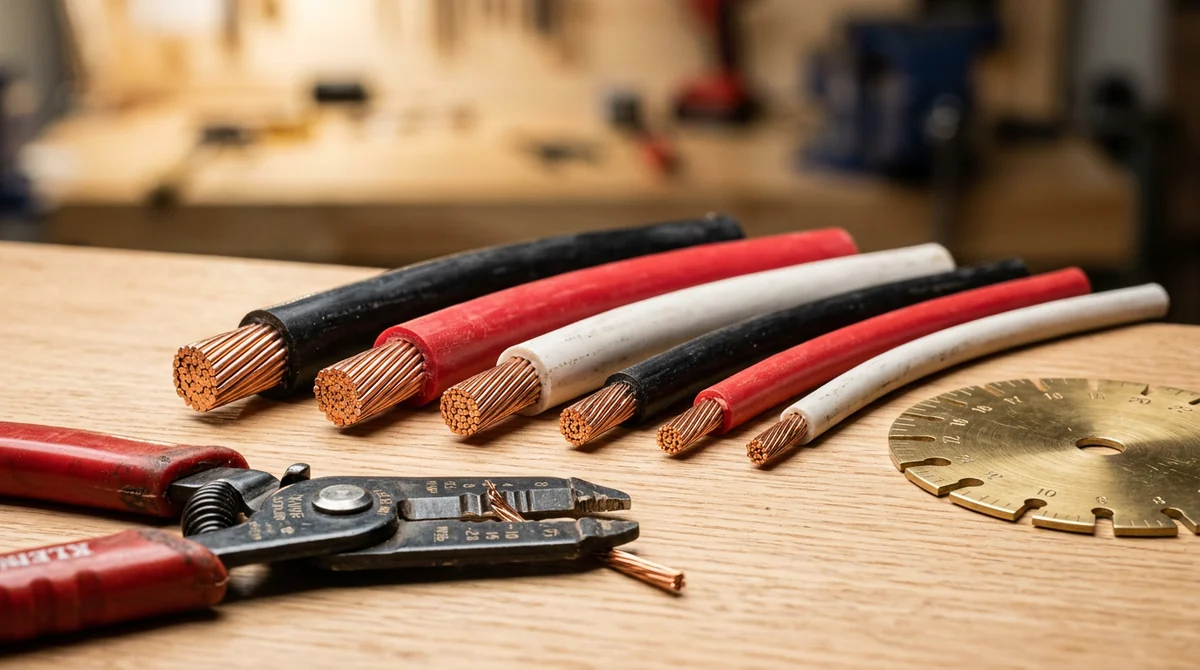
The calculator above runs both checks at once and returns the larger result, so you never have to remember which one governs.
What Size Wire Do I Need? Amps to AWG at a Glance
Minimum copper and aluminium conductor for each common breaker size, based on the NEC 75°C ampacity column. These are the starting sizes — check the run length before you buy, because distance frequently pushes the answer one or two gauges larger.
| Breaker / Load | Copper AWG | Aluminium AWG | Typical use |
|---|---|---|---|
| 15 A | 14 AWG | — | Lighting circuits |
| 20 A | 12 AWG | 10 AWG | Kitchen and general outlets |
| 30 A | 10 AWG | 8 AWG | Dryer, water heater, RV hookup |
| 40 A | 8 AWG | 6 AWG | Electric range, small subpanel |
| 50 A | 8 AWG (6 AWG at 60°C) | 6 AWG | Range, EV charger, welder, RV |
| 60 A | 6 AWG | 4 AWG | Subpanel, hot tub |
| 70 A | 4 AWG | 3 AWG | Larger subpanel |
| 100 A | 3 AWG (4 AWG for a dwelling service) | 1 AWG (2 AWG service) | Garage feeder, small service |
| 125 A | 1 AWG | 1/0 AWG | Large subpanel |
| 150 A | 1/0 AWG | 2/0 AWG | Service entrance |
| 200 A | 3/0 AWG (2/0 for a dwelling service) | 4/0 AWG | Main service entrance |
Two footnotes that trip people up. NEC 240.4(D) caps the small conductors regardless of what the ampacity table says: 14 AWG is limited to 15 A, 12 AWG to 20 A, 10 AWG to 30 A. And NEC 310.12 lets dwelling service and main feeder conductors run smaller than the general table — which is why a 200 amp house service is commonly 2/0 copper rather than 3/0.
How to Calculate Wire Size for Amps
Two checks, then take the larger conductor.
Check one — ampacity. Find the smallest conductor whose rated ampacity meets or exceeds your load. If the load is continuous (three hours or more, such as an EV charger), size for 125% of it. Then derate for ambient temperature and for more than three current-carrying conductors in a raceway.
Check two — voltage drop. Work out the drop over the run and step up until it falls inside your limit. The NEC recommends 3% on a branch circuit and 5% across feeder plus branch combined. Our Voltage Drop Calculator shows this in detail, and the Cable Size Calculator covers the metric side.
A worked example: a 50 amp subpanel at 240 V. Ampacity says 6 AWG, and at 120 feet that is genuinely fine — 2.45%. Push the same feeder to 200 feet and it reaches 4.09%, so the conductor has to go up to 4 AWG. Nothing about the load changed; only the distance did.
AWG Wire Size Chart: Amps, mm² and Resistance
American Wire Gauge runs backwards — a smaller number means a thicker conductor, and every three gauges roughly doubles the cross-sectional area. Ampacity below is copper at 75°C.
| AWG | mm² | Copper amps (75°C) | Ω / km |
|---|---|---|---|
| 14 AWG | 2.08 | 20 | 10.32 |
| 12 AWG | 3.31 | 25 | 6.50 |
| 10 AWG | 5.26 | 35 | 4.07 |
| 8 AWG | 8.37 | 50 | 2.55 |
| 6 AWG | 13.3 | 65 | 1.61 |
| 4 AWG | 21.2 | 85 | 1.01 |
| 3 AWG | 26.7 | 100 | 0.80 |
| 2 AWG | 33.6 | 115 | 0.64 |
| 1 AWG | 42.4 | 130 | 0.50 |
| 1/0 AWG | 53.5 | 150 | 0.40 |
| 2/0 AWG | 67.4 | 175 | 0.32 |
| 3/0 AWG | 85.0 | 200 | 0.25 |
| 4/0 AWG | 107.2 | 230 | 0.20 |
Working from metric drawings? The AWG to mm² Converter handles sizes between these rows.
Wire Size for 12V DC, 24V and 48V Systems
Low-voltage DC follows completely different rules, and this is where most sizing mistakes happen. At 12 volts, a 3% allowance is just 0.36 V — so voltage drop, not ampacity, decides the conductor almost every time.
Take a 12 V circuit pulling 80 amps over 15 feet, a typical car audio amplifier run. Ampacity alone allows 4 AWG. Hold the drop to 3% and you need 1/0 AWG — three sizes heavier. Switch the calculator above to DC and the 12 V preset to see it.
Marine and RV practice (ABYC E-11) splits the limit by criticality: 3% for bilge pumps, navigation lights, electronics and panel feeds, and 10% for non-critical loads such as cabin lighting or accessory sockets. Applying 3% everywhere on a boat produces absurdly heavy cable; applying 10% to a bilge pump is unsafe.
The same logic drives solar and battery work. A battery-to-inverter run is short but carries enormous current, so it is sized almost entirely by drop — 100 amps over six feet at 12 V still needs 3 AWG. Moving a system from 12 V to 24 V halves the current and quarters the drop for the same power, which is exactly why larger off-grid installations run at 48 V. For the storage side, see the Battery Backup Calculator.
How Many Amps Can Each Gauge Handle?
The reverse lookup — you have the wire and want to know what it will safely carry. Copper, 75°C column, before any derating:
14 AWG → 15 A
Rated 20 A but capped at 15 A by NEC 240.4(D).
12 AWG → 20 A
Rated 25 A, capped at 20 A on branch circuits.
10 AWG → 30 A
Rated 35 A, capped at 30 A. Dryers and water heaters.
8 AWG → 50 A
No small-conductor cap above 10 AWG.
6 AWG → 65 A
Subpanels, hot tubs, larger EV chargers.
4 AWG → 85 A
Feeders and 100 A dwelling services.
The NEC Rules That Change the Answer
Four adjustments turn a table lookup into a real answer:
Continuous loads (210.19). Anything drawing full current for three hours or more must be sized at 125%. A 40 amp EV charger is therefore a 50 amp calculation.
Terminal temperature rating (110.14(C)). You may only use the 75°C column if the breaker and lugs are rated for 75°C. Much residential equipment is 60°C rated, which is why a 50 amp circuit sometimes needs 6 AWG rather than 8 AWG.
Bundling and ambient heat (310.15). More than three current-carrying conductors in one raceway, or a hot attic, forces a derating factor that can cost you a full gauge size.
Aluminium needs upsizing. Roughly 1.6× the resistivity of copper for the same area, so plan on one to two sizes larger. It is lighter and cheaper on long feeders, but the terminations demand the correct antioxidant compound and torque. For the fault side of the design, check the Short Circuit Current Calculator.
Manufacturers publish the real numbers for the specific cable you are buying — conductor makers such as Prysmian list ampacity, insulation temperature rating and dimensions for every construction, and those beat any generic chart when the margin is tight.
More tools of this kind are collected in our engineering calculators hub.
Frequently Asked Questions
How do I calculate wire gauge?
To correctly calculate wire gauge, you must perform a dual-check. First, calculate the ampacity required to safely carry the current without overheating, factoring in continuous loads and temperature derating. Second, calculate the voltage drop over the intended distance to ensure it remains under 3%. You must select the thicker wire size dictated by these two calculations.
What wire size do I need for my current and distance?
The required wire size depends on the load current, system voltage, and total cable length. For short distances, standard ampacity rules apply (e.g., 12 AWG for 20 Amps). However, as distance increases, wire resistance causes voltage drop. For long runs, you must often step up to a thicker wire (like 10 AWG or 8 AWG) to maintain efficient power delivery.
How much voltage drop is acceptable?
The National Electrical Code (NEC) recommends a maximum voltage drop of 3% for individual branch circuits or feeder circuits, and a total combined voltage drop (feeder plus branch circuit) of no more than 5%.
Is copper better than aluminum wire?
Copper is a superior electrical conductor with lower resistance, allowing you to use a thinner wire for a given load. Aluminum is less conductive and requires a thicker wire (usually one or two gauge sizes larger) for the same load. However, aluminum is significantly lighter and more cost-effective, making it very popular for long, heavy feeder runs.
What is the difference between AWG and mm²?
AWG stands for American Wire Gauge, the standard electrical wire sizing system used in North America, where a smaller number represents a thicker wire. The rest of the world typically measures wire by its physical cross-sectional area in square millimeters (mm²), where a larger number indicates a thicker wire.
Should wire size be based on ampacity or voltage drop?
Wire size must be based on both. Ampacity dictates the minimum safe size to prevent the wire from overheating and creating a fire hazard. Voltage drop dictates the minimum size needed to efficiently deliver power over a distance so equipment functions properly. You must always choose the larger (thicker) wire size required between the two calculations.
What wire gauge do I need for a 20 amp circuit?
For a standard 20 amp circuit, the National Electrical Code (NEC) requires a minimum of 12 AWG copper wire. However, if the wire run is exceptionally long (typically over 50-100 feet depending on voltage), you may need to upgrade to 10 AWG to prevent excessive voltage drop.
Does wire length affect gauge size?
Yes, wire length heavily impacts the required gauge size. The longer a wire is, the more electrical resistance it has. To push current over a long distance without losing voltage (voltage drop) or creating dangerous heat, you must use a thicker wire (a lower AWG number).
Why do I need a thicker wire for continuous loads?
The NEC defines a continuous load as any device that runs at maximum current for 3 hours or more (like an EV charger or a heater). Continuous loads generate persistent heat, so you must size the wire to handle 125% of the actual load to prevent the insulation from melting.
What size wire do I need for a 50 amp breaker?
For a 50 amp breaker, 8 AWG copper is the minimum where the terminations are rated 75°C, and 6 AWG copper where they are only rated 60°C, which is common on residential equipment. Aluminium needs 6 AWG. Those figures hold for short runs only. A 50 amp feeder at 240 V stays inside 3% voltage drop on 6 AWG out to roughly 150 feet, but at 200 feet it reaches 4.09% and must move up to 4 AWG.
What size wire is needed for a 100 amp service?
A 100 amp dwelling service is normally 4 AWG copper or 2 AWG aluminium. That is smaller than the general ampacity table suggests because NEC 310.12 permits reduced conductors for dwelling services and main feeders. For a 100 amp feeder that is not a dwelling service, size from the standard table instead, which calls for 3 AWG copper.
What size wire for a 200 amp service?
A 200 amp dwelling service typically uses 2/0 copper or 4/0 aluminium under the NEC 310.12 dwelling allowance. Outside that allowance, the general table requires 3/0 copper. Because service conductors are usually short, ampacity governs rather than voltage drop, but always confirm the terminal temperature rating on the meter base and main breaker before settling on a size.
How many amps can 10 gauge wire handle?
10 AWG copper is rated 35 amps in the NEC 75°C column, but NEC 240.4(D) caps it at 30 amps for overcurrent protection, so a 30 amp breaker is the practical maximum. That makes it the standard choice for electric dryers, water heaters and 30 amp RV hookups. Over long runs voltage drop may still require 8 AWG even though the ampacity is adequate.
What size wire do I need for a 12 volt system?
Low-voltage DC is sized by voltage drop rather than ampacity, because a 3% allowance at 12 volts is only 0.36 V. An 80 amp car audio run over 15 feet needs 1/0 AWG even though ampacity alone would permit 4 AWG. Marine and RV practice under ABYC E-11 allows 3% for critical circuits such as bilge pumps and navigation lights, and 10% for non-critical loads.
Figures follow standard NEC ampacity tables and assume normal operating conditions. Actual requirements vary with insulation type, ambient temperature, conductor bundling, terminal ratings and local amendments. Use these results for planning and have a licensed electrician verify any final design before installation.