
Did you like the tool?
Did we solve your problem?
Rate the tool
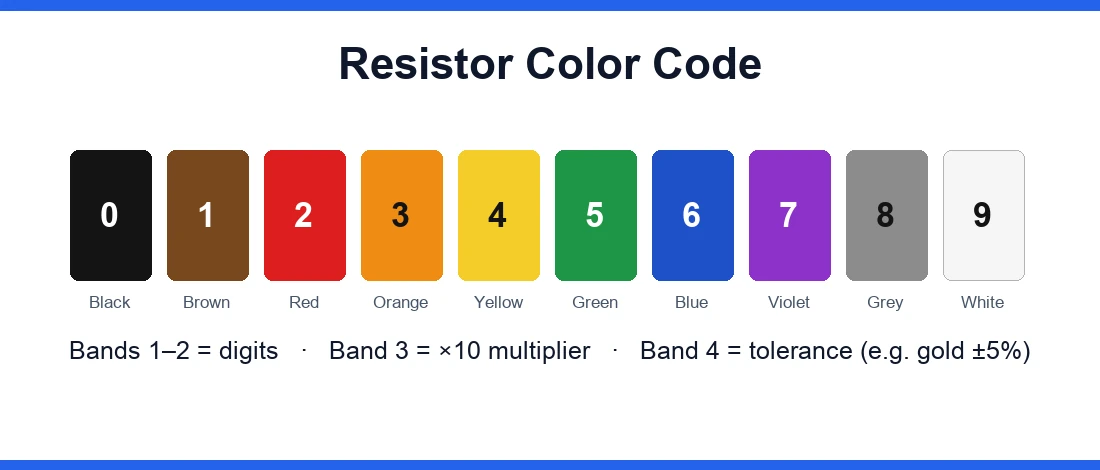
How to read a resistor’s color bands
A resistor’s value is printed as colored bands, read from the end where the bands are grouped closest together. Each color maps to a number (see the chart above), and the position of the band tells you whether it is a digit, the multiplier, or the tolerance:
- 4-band resistor: bands 1–2 are the first two digits, band 3 is the ×10ⁿ multiplier, and band 4 is the tolerance.
- 5-band resistor: bands 1–3 are three digits, band 4 is the multiplier, and band 5 is the tolerance — used for precision resistors.
- 6-band resistor: the same as a 5-band, plus a final band for the temperature coefficient.
Worked example
Take a 4-band resistor with the bands brown, black, red, gold. Brown = 1 and black = 0, giving the digits “10”. Red as the multiplier means ×100. So 10 × 100 = 1,000 Ω = 1 kΩ, and the gold band means a tolerance of ±5% — so the true value lies between 950 Ω and 1,050 Ω.
The calculator above works in either direction: pick the band colors to read the value, or enter a resistance to see the matching band pattern.
Frequently Asked Questions
What is a resistor color code?
A resistor color code is an electronic industry standard (EIA) used to indicate the resistance value, tolerance, and sometimes the temperature coefficient of an axial-lead resistor. Color bands are painted onto the component's body because traditional through-hole resistors are often too small to print legible text or numbers on.
How do you read resistor color bands?
Always read resistor color bands from left to right. To find the correct orientation, look for a band that is spaced slightly further apart from the others—this is the tolerance band and it goes on the right. The bands clustered on the left represent your significant digits, followed by your multiplier band.
What does the gold band mean on a resistor?
The meaning of a gold band depends on its position. When it is the very last band on the right, it indicates a manufacturing tolerance of ±5%. If the gold band is acting as the multiplier (the band just before the tolerance), it means you multiply the preceding digits by 0.1.
How do you calculate resistor tolerance?
Tolerance represents the acceptable margin of error from the stated value. To calculate it, multiply the total calculated resistance by the tolerance percentage. For example, a 1,000 Ω resistor with a Gold band (±5%) can vary by 50 Ω, meaning its actual physical resistance will measure anywhere between 950 Ω and 1,050 Ω.
How do you read a 4-band resistor?
To read a 4-band resistor, hold the tolerance band (usually gold or silver, sitting slightly apart from the others) on the right. The first two bands represent the significant digits, the third band is the multiplier (how many zeros to add), and the fourth band is the tolerance percentage.
What is the difference between a 4-band and 5-band resistor?
A 5-band resistor is used for higher precision components. While a 4-band resistor only uses two significant digits before the multiplier, a 5-band resistor uses three significant digits before the multiplier, allowing for much more specific resistance values.
What does the 6th band on a resistor mean?
On a 6-band resistor, the first five bands operate exactly like a standard 5-band high-precision resistor. The 6th band indicates the Temperature Coefficient, which tells you how much the resistance will change as the component's temperature fluctuates (measured in ppm/K or ppm/°C).