
Did you like the tool?
Did we solve your problem?
Rate the tool
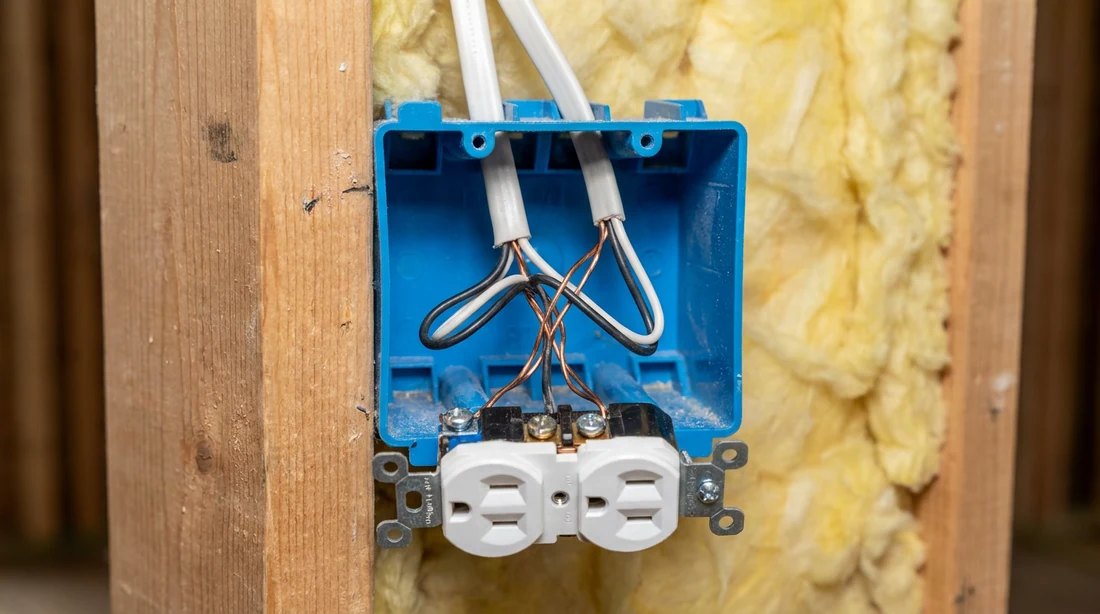
How the box fill calculator works
Most box fill calculators online take a shortcut: they ask for your largest wire size and price every conductor at that size. It is quick, it is always conservative, and it is not what the code says.
NEC 314.16(B)(1) prices each conductor at its own gauge. Only the other five categories — clamps, support fittings, device yokes, grounds and terminal blocks — use the largest conductor in the box. On a box wired entirely in 12 AWG the two methods agree exactly. Put two 16 AWG fixture wires into a 12 AWG box and they diverge: the shortcut charges you 2.25 cubic inches for wires the code prices at 1.75.
That difference is small until it is not. Worked through a real mixed-gauge box — six 12 AWG conductors, two 16 AWG, five grounds, two devices and clamps — the shortcut returns 32.06 cubic inches and the code returns 31.06. A full cubic inch, which is most of a 16 AWG conductor, on a calculation where people are routinely deciding between an 18 and a 21 cubic inch box.
What comes out: total cubic inches required, box capacity, remaining volume, percent full, a pass or fail verdict, the smallest box in Table 314.16(A) that legally holds your calculation, and an itemised breakdown showing every allowance with the code section it came from. Enter conductors by gauge, separately for terminating, passing through, and long loops.
The six things that count, and what each one costs
Box fill has two independent questions per item: how many allowances does it claim, and which wire size are those allowances priced at? Confuse the two and the arithmetic falls apart quietly.
| What | Section | Allowances | Priced at | Notes |
|---|---|---|---|---|
| Conductors | 314.16(B)(1) | 1 each | Its own gauge | Terminating, spliced, or passing straight through. A long loop counts twice. |
| Internal clamps | 314.16(B)(2) | 1 total | Largest conductor | One allowance no matter how many clamps. External clamps count nothing. |
| Studs and hickeys | 314.16(B)(3) | 1 each | Largest conductor | Luminaire studs and hickeys, counted individually. |
| Device yokes | 314.16(B)(4) | 2 each | Largest conductor on that device | Doubled again for every gang a wide device needs. |
| Equipment grounds | 314.16(B)(5) | 1 for the first four, then ¼ each | Largest ground | Changed in the 2020 NEC. An isolated-ground set adds one more. |
| Terminal blocks | 314.16(B)(6) | 1 each | Largest conductor terminated | New in the 2023 NEC. |
The clamp rule catches people out in the useful direction. One allowance covers every internal clamp in the box, so a four-cable box with four clamps pays for one. External clamps — the kind that grip the cable outside the knockout — cost nothing at all.
The ground rule changed in 2020, and most charts still have it wrong
From the 1971 edition through to 2017, all the equipment grounding conductors in a box claimed a single volume allowance, however many there were. Eight grounds, one allowance. That rule is now three code cycles out of date, and it is still what a lot of published box fill material says.
The 2020 NEC split it. The first four grounds still share one allowance. Every ground after the fourth adds a quarter allowance, priced on the largest ground present.
| Grounds in box | Pre-2020 | 2020 NEC on | Volume at 12 AWG | Difference |
|---|---|---|---|---|
| 1 | 1.00 | 1.00 | 2.25 in³ | +0.00 in³ |
| 2 | 1.00 | 1.00 | 2.25 in³ | +0.00 in³ |
| 3 | 1.00 | 1.00 | 2.25 in³ | +0.00 in³ |
| 4 | 1.00 | 1.00 | 2.25 in³ | +0.00 in³ |
| 5 | 1.00 | 1.25 | 2.81 in³ | +0.56 in³ |
| 6 | 1.00 | 1.50 | 3.38 in³ | +1.12 in³ |
| 8 | 1.00 | 2.00 | 4.50 in³ | +2.25 in³ |
| 10 | 1.00 | 2.50 | 5.62 in³ | +3.38 in³ |
| 12 | 1.00 | 3.00 | 6.75 in³ | +4.50 in³ |
Why the change? A multi-circuit splice box can easily carry eight or ten bare grounds, and pretending they occupy the space of one conductor was allowing boxes to be packed well past what anyone would call reasonable. The fractional penalty is deliberately gentle — it is a nudge, not a redesign.
The device rule: why one switch costs two wires
A single receptacle takes as much calculated volume as two conductors. Not because the yoke is physically that big, but because 314.16(B)(4) says a double allowance is made for each yoke or strap, priced on the largest conductor connected to that device.
On 12 AWG that is 4.50 cubic inches for one device — a quarter of an 18 cubic inch box before a single wire is counted. It is the largest single line item in most residential box fill calculations and the one most often left out entirely.
The 2020 code added a wrinkle worth knowing. A device wider than a single 2-inch gang doubles again for each gang it needs. Large smart dimmers, some occupancy sensors and combination devices land here. A two-gang device is four allowances, not two.
Volume allowance by wire size
Seven numbers, and 14 and 12 AWG cover almost everything in a house.
| Conductor | Cubic inches | cm³ | Typically |
|---|---|---|---|
| 18 AWG | 1.50 | 24.6 | Fixture wire, low-voltage |
| 16 AWG | 1.75 | 28.7 | Fixture wire |
| 14 AWG | 2.00 | 32.8 | 15 A lighting circuits |
| 12 AWG | 2.25 | 36.9 | 20 A receptacle circuits |
| 10 AWG | 2.50 | 41.0 | 30 A circuits |
| 8 AWG | 3.00 | 49.2 | 40 A circuits |
| 6 AWG | 5.00 | 81.9 | 55 A circuits and feeders |
The bottom of that table is a genuine boundary, not a rounding point. Table 314.16(B)(1) has no entry above 6 AWG, because conductors larger than that are not sized by box fill at all — see the section further down. If you are sizing conductors rather than boxes, the wire gauge calculator handles ampacity and the cable size calculator covers voltage drop.
Standard box volumes from Table 314.16(A)
If a box is listed in Table 314.16(A) you may use the table volume. If it is not — and most non-metallic boxes are not — the manufacturer must mark the volume durably inside the box, and that marking is what you use. Manufacturers such as Hubbell mould it into the back or a side wall.
| Box trade size | in³ | 14 AWG max | 12 AWG max | 10 AWG max |
|---|---|---|---|---|
| 4 x 1¼ round/octagonal | 12.5 | 6 | 5 | 5 |
| 4 x 1½ round/octagonal | 15.5 | 7 | 6 | 6 |
| 4 x 2⅛ round/octagonal | 21.5 | 10 | 9 | 8 |
| 4 x 1¼ square | 18.0 | 9 | 8 | 7 |
| 4 x 1½ square | 21.0 | 10 | 9 | 8 |
| 4 x 2⅛ square | 30.3 | 15 | 13 | 12 |
| 4 11/16 x 1¼ square | 25.5 | 12 | 11 | 10 |
| 4 11/16 x 1½ square | 29.5 | 14 | 13 | 11 |
| 4 11/16 x 2⅛ square | 42.0 | 21 | 18 | 16 |
| 3 x 2 x 1½ device | 7.5 | 3 | 3 | 3 |
| 3 x 2 x 2 device | 10.0 | 5 | 4 | 4 |
| 3 x 2 x 2¼ device | 10.5 | 5 | 4 | 4 |
| 3 x 2 x 2½ device | 12.5 | 6 | 5 | 5 |
| 3 x 2 x 2¾ device | 14.0 | 7 | 6 | 5 |
| 3 x 2 x 3½ device | 18.0 | 9 | 8 | 7 |
| 4 x 2⅛ x 1½ device | 10.3 | 5 | 4 | 4 |
| 4 x 2⅛ x 1⅞ device | 13.0 | 6 | 5 | 5 |
| 4 x 2⅛ x 2⅛ device | 14.5 | 7 | 6 | 5 |
| 3¾ x 2 x 2½ masonry box/gang | 14.0 | 7 | 6 | 5 |
| 3¾ x 2 x 3½ masonry box/gang | 21.0 | 10 | 9 | 8 |
| FS — single cover/gang | 13.5 | 6 | 6 | 5 |
| FD — single cover/gang | 18.0 | 9 | 8 | 7 |
| FS — multiple cover/gang | 18.0 | 9 | 8 | 7 |
| FD — multiple cover/gang | 24.0 | 12 | 10 | 9 |
Two practical notes. Ganged boxes add their individual volumes together, so two 3 × 2 × 2½ devices ganged make 25 cubic inches. And plaster rings, extension rings and raised covers add volume too — but only the volume marked on them, which is often smaller than it looks.
What does not count
The code is more generous here than most people assume, and knowing what to leave out is worth real cubic inches.
- Pigtails. A conductor no part of which leaves the box is not counted. Make up your splices with pigtails and none of them cost you anything.
- Wire connectors. Wire nuts, push-ins and crimps have no allowance in 314.16.
- External cable clamps. Only clamps inside the box count, and then only once for all of them together.
- Small fixture wires from a canopy. Up to four conductors smaller than 14 AWG entering a box from a domed luminaire canopy are excluded, along with an equipment grounding conductor with them.
What does count and gets forgotten: a cable that passes straight through the box without being spliced. It never terminates, nobody thinks of it as being in the box, and it claims exactly the same allowance as one that does.
Worked examples
Seven boxes you will actually wire, each calculated with conductors priced at their own gauge and internal clamps assumed.
| Scenario | Wires | Yokes | Grounds | Required in³ | Smallest legal box |
|---|---|---|---|---|---|
| Single switch, 2 cables | 4 | 1 | 2 | 16.00 | 4 x 1¼ square (18.0 in³) |
| 20 A receptacle, 2 cables | 4 | 1 | 2 | 18.00 | 4 x 1¼ square (18.0 in³) |
| 3-way switch, 3 cables | 9 | 1 | 3 | 26.00 | 4 11/16 x 1½ square (29.5 in³) |
| 2-gang switches, 3 cables | 7 | 2 | 3 | 26.00 | 4 11/16 x 1½ square (29.5 in³) |
| Ceiling light with stud | 6 | 0 | 3 | 18.00 | 4 x 1¼ square (18.0 in³) |
| Junction box, 4 cables | 8 | 0 | 4 | 22.50 | FD — multiple cover/gang (24.0 in³) |
| Junction box, 6 cables | 12 | 0 | 6 | 32.62 | 4 11/16 x 2⅛ square (42.0 in³) |
The last two rows are the argument for oversizing splice boxes. A junction box with six 12 AWG cables through it needs 32.62 cubic inches, which no standard device box comes close to. It is also where the 2020 ground rule shows up in practice: those six grounds claim 1.5 allowances now, where they would have claimed 1.0 under the older code.
When 314.16 stops applying
People search for box fill on 500 MCM feeders, and the honest answer is that box fill does not apply to them. There is no volume allowance for anything above 6 AWG.
Two boundaries end the box fill method:
- Conductors 4 AWG and larger. Boxes and conduit bodies containing them are sized under 314.28, which works from raceway trade sizes and pulling geometry — straight pulls need eight times the largest raceway, angle and U pulls six times — rather than from cubic inches.
- Boxes over 100 cubic inches. Beyond that volume 314.16 hands off to 314.28 as well.
If what you actually need is raceway capacity rather than box capacity, that is a different calculation entirely and the conduit fill calculator handles it against NEC Chapter 9. More electrical tools sit in the engineering calculators collection.
Why the limit exists
Box fill is not about whether the cover will close. It is a heat rule and a damage rule wearing an arithmetic costume.
Conductors carrying current generate heat, and a box buried in an insulated wall cavity has nowhere to put it. Overfill the box and the insulation on the conductors runs hotter than its 60°C or 75°C rating over years of thermal cycling, which is how conductor insulation ends up brittle and cracked decades after a job passed inspection. The second reason is blunter: forcing conductors into a box that will not take them damages the insulation mechanically as you fold them in, and the damage happens exactly where the wire bends around a device yoke.
The full code text lives with the NFPA, which publishes NFPA 70 and can be read free after registration. Box dimensions themselves are standardised through NEMA.
Frequently asked questions
How many wires can I put in an electrical box?
It depends on the wire size, the box volume and what else is inside. A 4-inch square box 1¼ inches deep holds 18 cubic inches, which is nine 14 AWG conductors on their own. Add one receptacle, internal clamps and two grounds and only four conductors fit. The device alone costs two allowances, so the honest answer is always to calculate rather than count.
Do grounds count in box fill?
Yes, but not one each. All the equipment grounding conductors together claim a single volume allowance based on the largest of them, up to four grounds. From the fifth ground onward the 2020 NEC adds a quarter allowance each. Six 12 AWG grounds therefore claim 1.5 allowances, or 3.38 cubic inches, rather than the flat 2.25 that older charts still show.
Do pigtails count in a box fill?
No. NEC 314.16(B)(1) counts a conductor only if part of it leaves the box, so a pigtail made up and terminated entirely inside is not counted. The same applies to short bonding jumpers between a ground screw and a device. This is genuinely free volume, and it is the one place where the code is more generous than people expect.
Do wire nuts count in box fill calculations?
No. Wire connectors have no volume allowance in 314.16 at all — not wire nuts, push-in connectors, or crimp sleeves. Only conductors, clamps, support fittings, device yokes, grounds and terminal blocks are counted. That said, a box calculated to exactly its limit and then packed with large connectors is physically hard to close, which is a workmanship problem rather than a code violation.
How much volume does a 12 AWG wire need in a box?
A 12 AWG conductor needs 2.25 cubic inches, from Table 314.16(B)(1). For the neighbouring sizes it is 2.00 for 14 AWG, 2.50 for 10 AWG and 3.00 for 8 AWG. Each conductor is priced at its own gauge, so a box with three 14 AWG and three 12 AWG conductors needs 12.75 cubic inches for the wires, not 13.50.
What size box do I need for a standard 20 A duplex receptacle?
A through-wired 20 A receptacle on 12 AWG needs 18.00 cubic inches: four conductors at 2.25, a doubled device allowance of 4.50, one clamp allowance of 2.25 and one ground allowance of 2.25. An 18 cubic inch box is exactly at the limit with nothing spare. A 4-inch square box at 21 cubic inches gives you room to work and costs almost nothing extra.
How do I calculate box fill for a switch with multiple cables?
Count every conductor entering the box, price each at its own gauge, then add the extras. A single switch fed by two 14 AWG cables comes to 16.00 cubic inches — four conductors at 2.00, the device at 2 × 2.00, clamps at 2.00 and grounds at 2.00. A three-way switch with three cables jumps to nine conductors and needs 26 cubic inches, which is past what a standard single-gang box holds.
What changed in NEC 2023 for box fill?
The 2023 edition added 314.16(B)(6), a volume allowance for terminal blocks. Each terminal block assembly now claims one allowance based on the largest conductor landed on it. The table of per-conductor allowances was also renumbered from Table 314.16(B) to Table 314.16(B)(1). The values in it did not change, so a calculation done to the 2020 numbers still produces the same conductor fill.
How do I calculate box fill fast?
Learn three numbers and the rest follows: 14 AWG is 2.00 cubic inches, 12 AWG is 2.25, and a device yoke costs two of whichever is largest. Count conductors, add two per yoke, add one for clamps, add one for the grounds, multiply. On a uniform 12 AWG box that is a single multiplication. Mixed gauges are where mental arithmetic starts costing you accuracy rather than saving time.
How do I calculate junction box fill?
A junction box is calculated the same way, minus the device allowance. Six 12 AWG cables spliced through a junction box means twelve conductors at 2.25, one clamp allowance, and six grounds claiming 1.5 allowances under the 2020 rule — 32.62 cubic inches in total. That is beyond every box in Table 314.16(A) except the deepest, which is why splice boxes get oversized so often.