
Did you like the tool?
Did we solve your problem?
Rate the tool
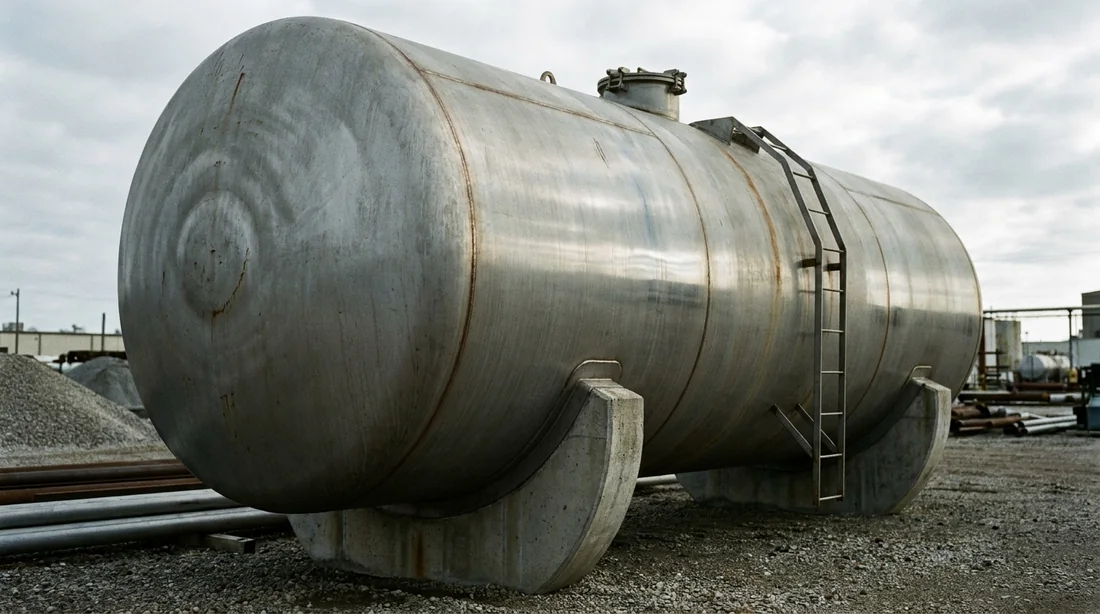
How the tank volume calculator works
Total capacity is the easy half. The number people actually need is how much is in the tank right now, and for anything other than a vertical cylinder or a box, that stops being proportional to the level almost immediately.
So the calculator does two separate calculations from the same dimensions. Capacity comes from the shape’s volume formula. The filled figure comes from the geometry of the liquid surface at your fill height — a circular segment in a horizontal cylinder, a spherical cap in a sphere or capsule end, a three-part piecewise calculation in a vertical oval. Enter a dipstick reading and you get gallons, not a percentage that quietly lies to you.
What comes out: total capacity and filled volume in US gallons, imperial gallons, litres, cubic feet, cubic metres and oil barrels; percent full; ullage; the weight of the contents once you pick a liquid; gallons gained per inch at the current level; and a full gallons-per-unit chart from empty to full that you can copy or download.
Tank volume formulas, shape by shape
Nine shapes cover almost everything in the field. The formulas themselves are ordinary solid geometry — it is the partial-fill column that separates a tank calculator from a volume calculator.
| Shape | Total capacity | You measure | Partial fill uses |
|---|---|---|---|
| Horizontal cylinder | V = πr²L | Diameter, length | Circular segment — the hard one |
| Vertical cylinder | V = πr²h | Diameter, height | Linear with level |
| Rectangular / box | V = l × w × h | Length, width, height | Linear with level |
| Horizontal oval | V = (πr² + 2ra)L | Width, height, length | Segment plus a rectangle |
| Vertical oval | V = (πr² + 2ra)L | Width, height, length | Three separate regimes |
| Horizontal capsule | V = πr²(a + 4r/3) | Diameter, straight side | Segment plus a spherical cap |
| Vertical capsule | V = πr²(a + 4r/3) | Diameter, straight side | Three separate regimes |
| Sphere | V = (4/3)πr³ | Diameter | Spherical cap |
| Cone-bottom | V = πh(R²+Rr+r²)/3 + πR²h₂ | Top & outlet diameter, cone and shell height | Cone first, then the shell |
Two of these are worth committing to memory because they come up constantly. A horizontal cylinder is πr²L. A vertical cylinder is πr²h. Same formula, different letter, and the distinction only matters when the tank is part full. For pure geometric shapes with no fill level involved, the volume calculator covers cubes, cones, pyramids and the rest.
Why a half-full horizontal tank is not half full
It is, actually — at exactly the centreline, and nowhere else. That is the trap. A horizontal cylinder filled to half its diameter holds precisely half its capacity, which convinces people the relationship is linear. It is not.
The liquid surface in a horizontal cylinder cuts a circular segment. Its area is:
θ = 2 × arccos((r − f) ÷ r)
A = ½ × r² × (θ − sin θ)
V(fill) = A × L
with θ in radians and f the fill depth. That single expression is valid from empty right through to full, which is worth knowing because a lot of published guidance tells you to calculate the empty space and subtract it once the tank passes halfway. You can, and you get the same answer, but you do not need to.
| Fill height | US gallons | % full | Gallons per inch |
|---|---|---|---|
| 4 in | 37.4 | 4.0% | 9.4 |
| 8 in | 103.0 | 11.0% | 16.4 |
| 12 in | 183.8 | 19.6% | 20.2 |
| 16 in | 274.3 | 29.2% | 22.6 |
| 20 in | 370.7 | 39.4% | 24.1 |
| 24 in | 470.0 | 50.0% | 24.8 |
| 28 in | 569.3 | 60.6% | 24.8 |
| 32 in | 665.7 | 70.8% | 24.1 |
| 36 in | 756.3 | 80.4% | 22.6 |
| 40 in | 837.0 | 89.0% | 20.2 |
| 44 in | 902.6 | 96.0% | 16.4 |
| 48 in | 940.0 | 100.0% | 9.4 |
Look at the last column rather than the middle two. Near the bottom of that tank an inch of level is worth about 13.6 gallons. Across the centreline the same inch is worth roughly 24.9. If you have ever watched a tank gauge sit still for an hour and then race, that is why — nothing changed except where the surface was.
Gallons per inch: turning a dipstick into a number
A dipstick gives you a length. Every question that follows — how much is left, how much to order, what has been used since Tuesday — needs a volume. The bridge between them is a strapping chart: a table of volume against depth, produced once for a specific tank and then used for years.
Fabricators supply these for custody-transfer vessels, calibrated by physically filling the tank in measured increments. For everything else — a farm diesel tank, a rainwater cistern, a workshop waste-oil drum — nobody is going to do that, and a calculated chart is close enough to plan from. That is what the table under the calculator is. Set the row spacing, and it prints volume, litres, percent full and the gallons gained in each step, from empty to the top.
Dished, elliptical and hemispherical heads
A pressure vessel does not end in a flat plate, because a flat plate is a terrible way to contain pressure. It ends in a curved head, and that head holds liquid the shell formula knows nothing about.
| Head type | Volume | 24 in | 36 in | 48 in | 72 in | Notes |
|---|---|---|---|---|---|---|
| Flat | 0 | 0.0 | 0.0 | 0.0 | 0.0 | Nothing added; the tank ends where the shell ends. |
| ASME flanged & dished | 0.0809 D³ | 4.8 | 16.3 | 38.7 | 130.7 | Dish radius equal to the diameter, knuckle radius 6% of it. The commonest pressure-vessel head. |
| 2:1 semi-elliptical | πD³/24 = 0.1309 D³ | 7.8 | 26.4 | 62.7 | 211.5 | Depth is a quarter of the diameter. Exactly twice the volume of an ASME F&D head. |
| Hemispherical | πD³/12 = 0.2618 D³ | 15.7 | 52.9 | 125.3 | 423.0 | A true half-sphere, and exactly twice a 2:1 elliptical head. |
The 1 : 2 : 4 ratio between ASME flanged-and-dished, 2:1 elliptical and hemispherical heads falls straight out of the geometry, and it is the quickest way to catch a mistake. On a 48-inch vessel, two hemispherical heads add 251 gallons — more than a quarter of what the straight section holds if that section is only a few feet long. Ignore them and your capacity is badly wrong. The head standards themselves come from ASME, whose Boiler and Pressure Vessel Code defines the dish and knuckle radii these formulas assume.
Both heads are added to total capacity by the calculator. It deliberately does not guess the partial-fill volume inside a curved head, because that needs a different integral for every head profile and getting it subtly wrong is worse than not offering it. The filled figure covers the straight side, and the tool says so on screen.
Gallons, litres, barrels and cubic feet
More tank calculations go wrong on units than on geometry. The US and imperial gallon are both called a gallon and differ by about a fifth.
| Unit | In litres | Also equals | Where you meet it |
|---|---|---|---|
| US gallon | 3.7854 litres | 231 cubic inches exactly | The default in the United States |
| Imperial gallon | 4.54609 litres | 0.8327 US gallons | UK and some Commonwealth suppliers |
| Cubic foot | 28.317 litres | 7.4805 US gallons | How a gas or grain volume is often quoted |
| Cubic metre | 1,000 litres | 264.17 US gallons | The SI unit; 1 m³ of water is 1 tonne |
| Oil barrel | 158.987 litres | 42 US gallons | A unit of account, not a physical drum |
The barrel deserves its own warning. As a unit it is 42 US gallons — 159 litres — and that is what the US Energy Information Administration means by the word. The blue steel drum in the yard is almost certainly a 55-gallon drum holding about 208 litres. Quoting one and delivering the other is a 31 percent error.
Water, fuel and septic tanks: what changes
Geometry does not care what is in the tank. Three practical things do.
Water and rainwater storage
Usable volume is less than capacity, sometimes much less. The outlet sits above the floor to leave sediment behind, and the top few inches are freeboard. Working from the volume between your low and high marks gives you a number you can plan supply against. Polyethylene tanks are moulded rather than fabricated, so the wall is not a constant thickness and published capacities from makers like Norwesco are the figure to trust over anything you calculate from outside dimensions.
Fuel and oil
Almost always a horizontal cylinder, which puts you straight into the segment maths above, and almost always gauged by dipstick. Temperature matters here in a way it does not for water: diesel expands roughly 0.08 percent per degree Fahrenheit, so a tank filled on a cold morning reads higher by the afternoon without a drop being added.
Septic and chemical
Septic tanks are usually sized by regulation rather than by arithmetic, and the working liquid level is set by the outlet invert, not the top of the tank. Chemical vessels are where dished heads and cone bottoms show up most, and where getting the head volume right stops being academic.
How much does the contents weigh?
Volume tells you what you are buying. Weight tells you whether the floor holds. Water is 8.345 pounds per US gallon, and everything else is that figure scaled by specific gravity.
| Liquid | Specific gravity | Per US gallon | 500 gallons weighs |
|---|---|---|---|
| Water | 1.000 | 8.35 lb | 4,173 lb |
| Milk | 1.030 | 8.60 lb | 4,298 lb |
| Diesel | 0.850 | 7.09 lb | 3,547 lb |
| Petrol / gasoline | 0.740 | 6.18 lb | 3,088 lb |
| Ethanol | 0.789 | 6.58 lb | 3,292 lb |
| Seawater | 1.025 | 8.55 lb | 4,277 lb |
A full 500-gallon water tank is over two tons sitting on a small footprint, which is why tank pads are specified rather than guessed. Fuel is lighter, at around 7.1 pounds per gallon for diesel. If you are working out what the slab under it needs, the cubic yard calculator will size the concrete.
Measuring a tank without getting it wrong
Every formula on this page assumes inside dimensions. Tape the outside of a steel tank and you will overstate the capacity by twice the wall thickness on the diameter, which on a small vessel is a real error.
- Diameter, not radius. The commonest single input error on any tank calculator is entering the radius in the diameter box, which quarters the answer.
- Straight side, not overall length. On a vessel with dished heads the shell length stops at the tangent line where the curve begins. Overall length includes both heads and will double-count them.
- Measure the fill from the lowest inside point. Not from the outside of the base, and not from the top down unless you then subtract.
- Check the tank is level. A horizontal cylinder out of level reads differently at each end, and the dipstick position becomes part of the measurement.
More estimating tools sit in the engineering calculators collection.
Fish tanks and aquariums
An aquarium is a rectangular tank and the arithmetic is the simplest on this page: length × width × height, divided by 1,000 if you measured in centimetres. A 90 × 45 × 45 cm tank comes to 182.25 litres.
Nobody runs an aquarium at its geometric volume, though. Substrate takes up two or three centimetres of depth, rock and hardscape displace more, and the water line sits below the rim to leave room for the lid and to stop spillage. Between them these routinely account for 10 to 15 percent, so the tank above holds nearer 155 litres of actual water. That distinction matters because dosing and medication are calculated per litre of water, not per litre of glass box — getting it wrong from the label volume is a common way to overdose a tank.
Frequently asked questions
How do you calculate tank capacity?
Multiply the cross-sectional area of the tank by its length or height, using inside dimensions. A cylinder is πr² times the length, so a 48-inch diameter tank 120 inches long holds 940 US gallons. A rectangular tank is simply length × width × height. Divide cubic inches by 231 to get US gallons, or cubic feet by 7.48. Curved end caps add volume on top of the straight section and have to be worked out separately.
How do you calculate the volume of a water tank?
Measure the inside diameter and the inside height, halve the diameter to get the radius, then multiply π × radius² × height. Convert the result to gallons or litres at the end rather than partway through. For a vertical water tank the level is proportional to the volume, so half the height really is half the water — that convenient relationship holds for vertical cylinders and rectangular tanks, and for nothing else on this page.
How do you calculate tank volume in litres?
Work in centimetres and the arithmetic is easy: volume in cubic centimetres divided by 1,000 gives litres. Working in metres gives cubic metres, and one cubic metre is exactly 1,000 litres. A tank 200 cm long, 100 cm wide and 80 cm deep holds 1,600,000 cm³, which is 1,600 litres. Coming from US units, one US gallon is 3.785 litres and one imperial gallon is 4.546.
How many litres is a 90x45x45 aquarium?
About 182.25 litres to the brim. Multiplying 90 × 45 × 45 gives 182,250 cubic centimetres, and dividing by 1,000 converts that to litres. In practice an aquarium never holds its full geometric volume: substrate, rock and equipment displace water, and the level sits below the rim. Subtracting 10 to 15 percent is the usual working assumption, which puts a tank this size nearer 155–165 litres of actual water.
What is the volume of an oil barrel?
An oil barrel is 42 US gallons, which is 159.0 litres. That figure is a unit of account rather than a physical container — crude oil has not routinely shipped in barrels for over a century, and the steel drum you see on a site is normally a 55-gallon drum holding about 208 litres. If a volume is quoted in barrels, convert at 42 US gallons unless the industry is beer or whisky, where the barrel is a different size again.
How long will the water in a tank last?
Divide the usable volume by the daily draw. A 500-gallon tank supplying a household using 80 gallons a day lasts a little over six days. Two adjustments matter: the outlet is rarely at the very bottom, so some volume is unusable, and a tank you are refilling should not be run to empty. Working from the volume between your low-level and high-level marks — not the full capacity — gives a number you can plan around.
Why are water tanks cylindrical rather than square?
A cylinder carries internal pressure in pure hoop tension, spreading the load evenly around the wall, so it needs less material than a rectangular tank of the same capacity. A flat wall has to resist the same pressure in bending, which means thicker plate or external stiffeners. Cylinders are also easier to clean, since there are no corners for sediment to collect in. The trade-off is that a cylinder wastes floor space that a rectangular tank would use.
How do you work out gallons per inch in a tank?
For a vertical cylinder it is a constant: the area of the base divided by the conversion factor, so a 48-inch tank gains about 7.83 gallons for every inch of depth all the way up. For a horizontal cylinder it is not constant at all — on the 48 by 120 inch tank above it is about 24.9 gallons per inch across the middle but only around 13.6 near the bottom. The chart under the calculator prints the figure at every level.
How do you calculate tank volume with dished ends?
Work out the straight cylindrical section first, then add the two heads. An ASME flanged and dished head holds about 0.0809 × the diameter cubed; a 2:1 semi-elliptical head holds πD³/24, and a hemispherical head twice that again. For a 48-inch vessel that is roughly 39, 63 and 125 gallons per head. Partial fill inside a dished head is a much harder calculation, which is why gauging charts for pressure vessels come from the fabricator.
How do you find the volume of a horizontal cylindrical tank?
Total capacity is πr² multiplied by the length. The partially filled volume needs the area of a circular segment: θ = 2 arccos((r − f) / r), then area = ½r²(θ − sin θ), multiplied by the length. That formula works across the whole range from empty to full without needing to switch methods halfway. Enter the fill height in the calculator above and it does the trigonometry for you.