
Quadratic Formula Calculator
Solve Quadratic Equations and Find Real or Complex Roots Instantly
Did you like the tool?
Did we solve your problem?
Rate the tool
Why the Quadratic Formula Calculator Is So Useful
A Quadratic Formula Calculator is one of the most practical math tools for students, teachers, exam candidates, engineers, analysts, and anyone who needs fast and accurate solutions for quadratic equations. Whenever an equation can be written in the standard form ax² + bx + c = 0, this tool helps find the values of x without the slow manual work that often leads to sign errors, arithmetic mistakes, or confusion about whether the equation has one, two, or no real roots.
The main value of a Quadratic Formula Calculator is speed combined with clarity. It does not simply show an answer. It helps users understand the structure of the equation, the role of each coefficient, and the meaning of the discriminant. That makes it useful for homework, classroom demonstrations, test preparation, algebra review, and technical calculations where a quadratic relationship appears in motion, geometry, optimization, and curve analysis.
It reduces calculation time, improves confidence, reveals whether solutions are real or complex, and lets users test multiple coefficient combinations quickly. That is especially helpful when comparing scenarios or checking work before submitting assignments, reports, or exam answers.
What the Quadratic Formula Calculator Does
The Quadratic Formula Calculator takes three inputs: a, b, and c. These values define the quadratic equation. Once the values are entered, the tool applies the quadratic formula, evaluates the discriminant, and returns the roots. Depending on the coefficients, the output may show two distinct real roots, one repeated real root, or two complex roots.
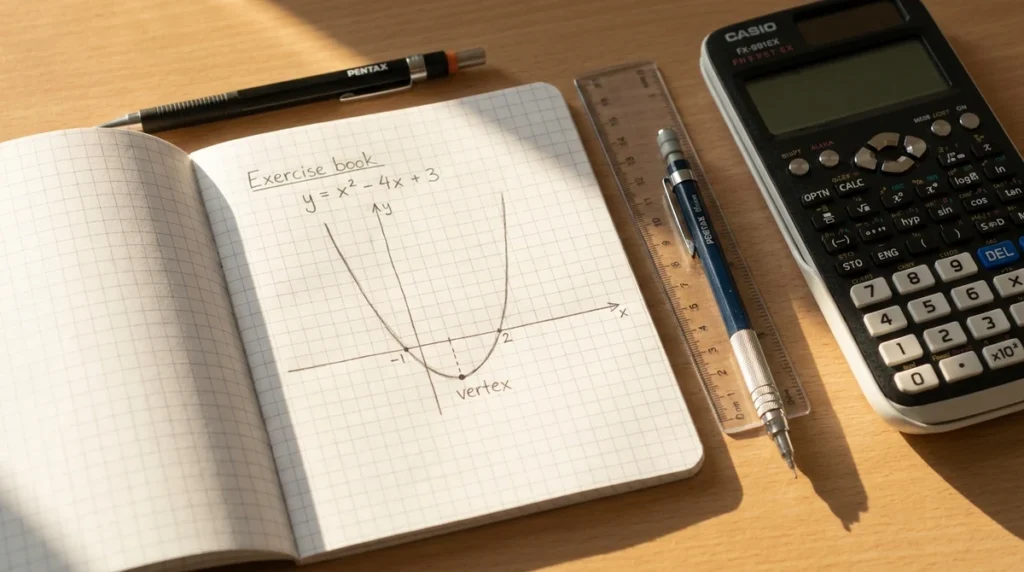
A good Quadratic Formula Calculator also helps users understand the type of answer they are getting. This is important because many people only focus on the final x-values and ignore the mathematical meaning behind them. In reality, the result can tell you whether a parabola crosses the x-axis, only touches it, or never reaches it in the real number system.
Coefficients a, b, and c from the equation ax² + bx + c = 0.
The tool computes the discriminant and applies the formula exactly.
Roots, root type, and a clearer interpretation of the equation.
How the Quadratic Formula Calculator Works
The Quadratic Formula Calculator follows a standard mathematical method accepted worldwide in algebra education and technical problem solving. First, it checks whether the equation is truly quadratic. That means the value of a must not be zero. If a equals zero, the equation is no longer quadratic and should be solved as a linear equation instead.
After confirming that the equation is quadratic, the Quadratic Formula Calculator evaluates the discriminant:
That single value determines the nature of the roots. Then the tool substitutes the values into the main formula:
| Discriminant Value | Meaning | Result Type |
|---|---|---|
| D > 0 | The parabola crosses the x-axis twice | Two distinct real roots |
| D = 0 | The parabola touches the x-axis once | One repeated real root |
| D < 0 | The parabola does not cross the x-axis in real numbers | Two complex roots |
Formulas and Calculation Logic Behind the Quadratic Formula Calculator
The Quadratic Formula Calculator is based on exact algebraic transformation rather than approximation. The quadratic formula itself comes from completing the square, which is a standard method taught in algebra and pre-calculus. This means the tool is grounded in recognized mathematical rules rather than an estimation shortcut.
For reference, the general logic used by a Quadratic Formula Calculator aligns with widely accepted mathematical practice found in school curricula, university algebra texts, and instructional references used internationally. If you want a general educational reference on quadratic equations and their interpretation, a stable source is the Encyclopaedia Britannica explanation of quadratic equations.
The formula only applies directly when the equation is written in the standard form ax² + bx + c = 0. If your expression is not arranged in that form first, even a reliable Quadratic Formula Calculator may appear to give the wrong answer because the wrong coefficients were entered.
In academic and technical settings, the underlying logic is consistent with international mathematics teaching frameworks and standardized algebra methods used in secondary and higher education. The strength of the Quadratic Formula Calculator is that it preserves that exact logic while removing routine arithmetic burden.
How to Interpret the Results from the Quadratic Formula Calculator
The output of a Quadratic Formula Calculator should always be read in context. If you receive two real roots, that means there are two x-values that make the equation equal to zero. If you get one repeated root, the graph only touches the x-axis at a single point. If the roots are complex, the equation still has valid algebraic solutions, but they are not located on the real x-axis.
Real roots: useful for graph intersections, physical modeling, and standard algebra tasks.
Repeated root: often indicates a minimum or maximum point just touching the axis.
Complex roots: mathematically correct, even if there is no real x-intercept on the graph.
Two real roots
Repeated root
Complex roots
Practical Examples and Real-Life Uses of the Quadratic Formula Calculator
A Quadratic Formula Calculator is useful far beyond homework. In education, it helps students verify textbook exercises quickly and focus more on understanding patterns in quadratic expressions. In engineering and science, quadratic models appear in trajectory calculations, area optimization, structural relationships, and simplified motion problems. In business and economics, quadratic functions can appear in revenue, profit, or cost models when change is not linear.
| Example Equation | What the Quadratic Formula Calculator Shows | Typical Use Case |
|---|---|---|
| x² - 5x + 6 = 0 | Roots: 2 and 3 | Basic algebra practice |
| x² - 4x + 4 = 0 | One repeated root: 2 | Graph interpretation |
| x² + 2x + 5 = 0 | Complex roots | Advanced algebra review |
For users exploring broader algebra tools after using the Quadratic Formula Calculator, it also makes sense to browse related resources in the Math Calculators category to compare different methods and practice additional problem types.
Step-by-step: solving a quadratic with the formula
The calculator does this instantly, but seeing the steps makes the results easy to trust. Take the equation 2x² + 5x − 3 = 0:
- Identify the coefficients: a = 2, b = 5, c = −3.
- Calculate the discriminant (b² − 4ac): 5² − 4 × 2 × (−3) = 25 + 24 = 49. A positive discriminant means two distinct real roots.
- Take the square root: √49 = 7.
- Apply the formula x = (−b ± √(b²−4ac)) / 2a: x = (−5 ± 7) / (2 × 2) = (−5 ± 7) / 4.
- Read both roots: x = (−5 + 7) / 4 = 0.5 and x = (−5 − 7) / 4 = −3.
You can check the answer by substituting each root back in: 2(0.5)² + 5(0.5) − 3 = 0 and 2(−3)² + 5(−3) − 3 = 0. Both hold, confirming the roots are correct.
How to solve a quadratic on a TI-84 or Casio calculator
A common question is how to do this on a physical exam calculator rather than online. The formula itself is the same — only the keystrokes differ:
- TI-84 (Plus / CE): press apps → PlySmlt2 (Polynomial Solver) → Polynomial Root Finder, set the order to 2, enter a, b and c, then press SOLVE to read both roots.
- Casio fx-991 (ES / EX): open Equation / EQN mode, choose a polynomial of degree 2 (ax² + bx + c), type a, b and c, then press =. Real or complex roots appear one at a time.
If you do not have the equation-solver app or you are away from your handheld, the calculator above returns the same roots, the discriminant and complex solutions instantly — no mode-switching required.
Common Mistakes to Avoid When Using the Quadratic Formula Calculator
Even the best Quadratic Formula Calculator depends on correct input. One of the most common mistakes is entering coefficients from an equation that has not been rearranged into standard form. Another frequent problem is forgetting that negative signs belong to the coefficient itself. For example, if the equation is x² - 7x + 10 = 0, then b = -7, not 7.
Users should also remember that a Quadratic Formula Calculator solves equations, not inequalities, unless the tool specifically states otherwise. The roots are starting points for deeper interpretation, not always the entire final answer in a larger application.
Entering the wrong sign for b or c
Using a = 0 and expecting a quadratic result
Reading complex roots as “wrong” instead of understanding what they mean
How the Quadratic Formula Calculator Improves Efficiency and Decision-Making
The Quadratic Formula Calculator saves time in classrooms, tutoring sessions, offices, labs, workshops, and technical review environments because it eliminates repetitive arithmetic while keeping the mathematical process transparent. That means faster checking, cleaner work, and fewer avoidable mistakes. For students, this can improve confidence and accuracy. For teachers, it helps demonstrate multiple scenarios quickly. For technical users, it supports faster verification when quadratic relationships appear inside a wider model.
Compared with manual solving, a Quadratic Formula Calculator is especially useful when you want to test several equations back to back, compare coefficient changes, and see how the discriminant affects the outcome. That makes the page more interactive and more valuable for users who want to learn by experimenting rather than only reading theory.
Quadratic Formula Calculator vs Manual Calculation
A Quadratic Formula Calculator is not a replacement for learning algebra. It is a precision aid. Manual solving is still useful for understanding the method, but the calculator is better for checking, repetition, accuracy, and exploring more cases in less time. That balance is why the Quadratic Formula Calculator remains valuable for beginners and advanced users alike.
| Method | Best Advantage | Main Limitation |
|---|---|---|
| Quadratic Formula Calculator | Fast, accurate, easy to compare many cases | Still requires correct coefficient entry |
| Manual calculation | Builds strong conceptual understanding | Slower and more error-prone |
A practical way to use the Quadratic Formula Calculator is to enter one equation, review the roots, then slightly change one coefficient and calculate again. That simple experiment shows how sensitive a quadratic equation can be and helps users build real intuition instead of memorizing a formula without understanding it.
Frequently Asked Questions
What is a Quadratic Formula Calculator?
A Quadratic Formula Calculator is a math tool that solves equations in the form ax² + bx + c = 0 by applying the quadratic formula to find the roots or solutions.
How does a Quadratic Formula Calculator work?
A Quadratic Formula Calculator takes the values of a, b, and c, calculates the discriminant b² - 4ac, and then uses the quadratic formula x = [-b ± √(b² - 4ac)] / 2a to find the solutions.
Can a Quadratic Formula Calculator show complex roots?
Yes, a Quadratic Formula Calculator can show complex roots when the discriminant is less than zero, meaning the quadratic equation has no real-number solutions.
When should I use a Quadratic Formula Calculator instead of factoring?
You should use a Quadratic Formula Calculator when the equation does not factor easily, when you want faster results, or when you need to verify your manual answer accurately.
What inputs are required in a Quadratic Formula Calculator?
A Quadratic Formula Calculator requires three inputs: the coefficient of x² called a, the coefficient of x called b, and the constant term c.