
Did you like the tool?
Did we solve your problem?
Rate the tool
Why a Transformer Load Calculator Is So Useful
A Transformer Load Calculator is one of the most practical tools for anyone working with electrical systems, distribution panels, motors, HVAC equipment, commercial buildings, workshops, or industrial feeders. Instead of relying on rough assumptions, this tool helps estimate how much load a transformer can safely carry, how close the connected demand is to the transformer rating, and whether spare capacity still exists for future expansion. That matters because transformer overloading can lead to overheating, insulation stress, poor voltage regulation, nuisance tripping, and shortened asset life.
A good Transformer Load Calculator is not only useful for design engineers. It also helps maintenance teams, consultants, facility managers, contractors, and even technically minded site owners make faster and better decisions. Whether you are reviewing a new feeder, checking if a workshop can add more machines, estimating demand for an office floor, or planning a small industrial expansion, the tool gives immediate guidance that would otherwise take repeated manual calculations.
A Transformer Load Calculator helps you check transformer loading percentage, estimate kVA demand, convert demand into current, and understand whether your installation is comfortably loaded, near its preferred limit, or already overloaded.
What the Transformer Load Calculator Does
This Transformer Load Calculator is designed to turn everyday electrical input data into meaningful operating results. Instead of only showing one number, it combines transformer rating, voltage, system type, power factor, diversity, connected load, operating hours, and energy rate to present a full practical picture. That means the user can see connected load in kW, apparent load in kVA, diversified demand, estimated current, loading percentage, spare capacity, recommended transformer size, and even a basic energy cost view for the entered demand pattern.
The Transformer Load Calculator becomes even more useful when multiple loads are added. Real installations rarely consist of one single load. A site may have lighting, air conditioning, pumps, process motors, sockets, control panels, and future spare feeders. By allowing multiple rows and demand assumptions, the tool behaves more like a real planning aid and less like a simple classroom example.
For readers who want to explore related tools in the same niche, you can also browse the engineering calculators category for more practical electrical and technical calculators.
How the Transformer Load Calculator Works
At its core, the Transformer Load Calculator gathers all included load rows, converts them into a common electrical basis, and then compares the result against the selected transformer capacity. If a user enters loads in kW, the tool can estimate apparent power in kVA using power factor. If multiple pieces of equipment are entered, quantity and run factor refine the real operating demand. If the loads are not expected to peak together, diversity can reduce the total to a more realistic demand estimate.
The Transformer Load Calculator also distinguishes between single-phase and three-phase systems. That is important because current calculation is different for each case. In a single-phase system, current depends mainly on apparent power and voltage. In a three-phase system, the square root of three becomes part of the relationship. This difference is critical when checking feeder size, breaker loading, cable ampacity, or actual operating current on the transformer secondary side.
Transformer Load Calculator Formulas and Calculation Logic
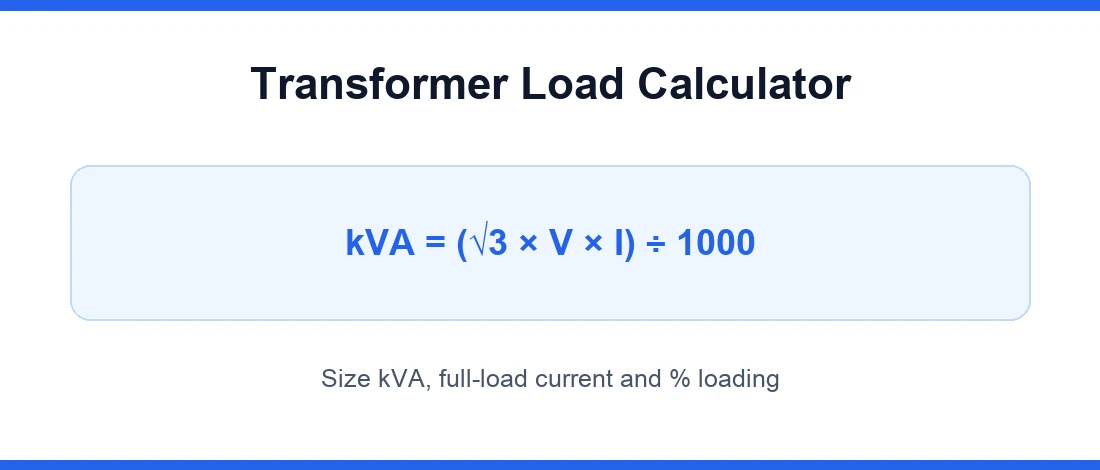
The Transformer Load Calculator is based on standard electrical relationships used in practical engineering work. Typical logic includes converting load to kW, converting kW to kVA using power factor, adjusting totals through diversity factor, and then comparing final demand with transformer nameplate rating. In general terms, kVA equals kW divided by power factor. Transformer loading percentage equals demand kVA divided by transformer kVA, multiplied by 100.
For current estimation, the Transformer Load Calculator uses standard single-phase and three-phase current equations. In single-phase systems, current is based on apparent power divided by voltage. In three-phase systems, current is based on apparent power divided by √3 times voltage. This approach is consistent with mainstream engineering practice and aligns with the type of reasoning used around international references such as IEC 60076 for power transformers and the IEEE C57 series for transformer application and rating considerations.
Connected kW → convert to kVA using PF → apply diversity if justified → compare with transformer rating → calculate loading % → estimate current and spare margin.
A useful external technical reference for transformer fundamentals can be found at the U.S. Department of Energy transformer resource page.
How to Interpret Transformer Load Calculator Results
A Transformer Load Calculator becomes most valuable when the user knows how to interpret the outputs properly. A low loading percentage generally means ample spare capacity, but very low utilization can also suggest oversizing. A moderate loading percentage often indicates a healthy operating range, especially when future growth is expected. A high loading percentage may still be technically possible, but it leaves less room for peak demand, future feeders, abnormal ambient conditions, or short-term overload events.
The Transformer Load Calculator should also be read together with current, spare capacity, and recommended transformer size. For example, a transformer may still appear acceptable in kVA terms, but the current result may highlight the need for stronger secondary cables, switchgear checks, or better coordination with downstream protection. Likewise, a spare capacity result below the preferred planning margin can be a warning that the system is workable today but not comfortable for tomorrow.
Do not look at only one output. The best use of a Transformer Load Calculator is to read loading percentage, demand current, spare kVA, and recommended transformer size together.
Practical Examples and Real-Life Uses for a Transformer Load Calculator
A Transformer Load Calculator is useful in homes with large connected air conditioning systems, villas with workshops, office floors with mixed lighting and HVAC, retail spaces with display loads, warehouses with motors and chargers, and industrial units with process machines. In a commercial building, the tool can help compare whether a transformer still has capacity for an extra tenant floor. In a workshop, it can help estimate whether adding two welders and a compressor will push the transformer too close to its preferred limit.
Another strong use of a Transformer Load Calculator is scenario testing. Users can enter current operating loads, then create a second scenario by increasing quantity, changing run factor, or adding a future motor. This quickly shows whether an upgrade is really necessary or whether better power factor and diversity assumptions already solve the issue. That kind of what-if testing keeps users engaged because the tool helps answer real project questions, not just textbook examples.
Transformer full-load current by kVA (three-phase)
Full-load current is what sizes a transformer’s protection and cabling. For a three-phase transformer it is FLA = (kVA × 1000) ÷ (√3 × line-to-line voltage). Here are the values for standard kVA ratings at the three most common secondary voltages (amps):
| Transformer rating | 208 V | 240 V | 480 V |
|---|---|---|---|
| 15 kVA | 42 | 36 | 18 |
| 30 kVA | 83 | 72 | 36 |
| 45 kVA | 125 | 108 | 54 |
| 75 kVA | 208 | 180 | 90 |
| 112.5 kVA | 312 | 271 | 135 |
| 150 kVA | 416 | 361 | 180 |
| 225 kVA | 625 | 541 | 271 |
| 300 kVA | 833 | 722 | 361 |
| 500 kVA | 1388 | 1203 | 601 |
| 750 kVA | 2082 | 1804 | 902 |
| 1,000 kVA | 2776 | 2406 | 1203 |
Notice the pattern — at a fixed kVA, a higher voltage means lower current, which is exactly why distribution runs at higher voltages to keep conductor sizes and losses down. For a single-phase transformer, drop the √3: FLA = (kVA × 1000) ÷ voltage.
Common Mistakes to Avoid When Using a Transformer Load Calculator
Even a very good Transformer Load Calculator can produce misleading results if the inputs are unrealistic. One common mistake is entering connected load but forgetting that some equipment will not run continuously at full value. Another common error is using an overly optimistic power factor. Some users also ignore diversity completely, while others apply too much diversity without site evidence. Both extremes can distort the result.
A second mistake is treating the Transformer Load Calculator as the only design decision tool. It should support engineering judgment, not replace it. Final decisions should still consider transformer temperature rise, ambient conditions, load profile, harmonic content, protection settings, cable ratings, and measured demand where available. The calculator is strongest when used as a fast planning and review tool backed by sound engineering judgment.
Why a Transformer Load Calculator Is Better Than Manual Calculation
Manual calculation can still work, but it takes more time, increases the chance of missed factors, and makes scenario comparison slow. A Transformer Load Calculator reduces repetitive work and makes it much easier to test safe loading, near-limit loading, overloaded cases, and future growth cases in seconds. That helps improve decision speed, reduce planning mistakes, and support more confident discussions between designers, reviewers, and site teams.
Most importantly, a Transformer Load Calculator encourages users to test several real-world scenarios instead of relying on one rough estimate. Try changing power factor, run factor, diversity, operating hours, and future load rows. That deeper interaction improves understanding, increases confidence in the result, and helps users make better decisions about transformer sizing, load expansion, energy cost awareness, and system reliability.